Plant Health Care
Insect and Disease Control in Lawrence and Topeka
Treatment for bagworms, borers, scale, and the fungal problems common in Kansas.
- Bagworm window
- Mid June
- Trunk injection
- $10 to $15 per inch of trunk diameter
- Foliar spray
- $60 to $80 per treatment, 3 to 4 visits a year
- Evergreen defoliation
- Often permanent
What this is
Most tree pest problems here are seasonal and beatable if the timing is right. Bagworms on juniper and spruce have to be treated when the larvae are small, which is roughly mid June in this part of Kansas. Treat in August and you are spraying a bag that the insect has already sealed itself into, which does nothing.
What the job includes
- Bagworm treatment timed to larval emergence, roughly mid June
- Borer prevention on stressed and newly planted trees
- Scale, aphid, and mite treatment
- Iron chlorosis correction on pin oaks and maples in high pH soil
- Fungal diseases including anthracnose and cedar apple rust
Timing decides whether treatment works
Most tree pest problems in northeast Kansas are beatable, and most failed treatments fail on the calendar rather than on the product. An insect is vulnerable during a specific window in its life cycle, and outside that window the same application at the same rate does nothing worth the money.
Bagworms are the clearest example. The larvae hatch and feed openly in late spring, and by August each one is sealed inside a bag it built out of the host plant. Spraying that bag is spraying a sealed container. The product cannot get in, the insect never touches it, and the homeowner concludes that treatment does not work when what actually happened is that treatment happened in the wrong month.
That is why we would rather book you for June than sell you an application in August. It is also why an accurate diagnosis matters before anything gets sprayed at all. Half the calls we get about a pest turn out to be a soil problem, a root problem, or drought.
Bagworms on juniper, spruce, and redcedar
Mid June is the window in this part of Kansas. The larvae are newly hatched, small, and feeding on the outside of the foliage where an application can reach them. Two weeks of drift either side of that is usually workable. Six weeks late is not.
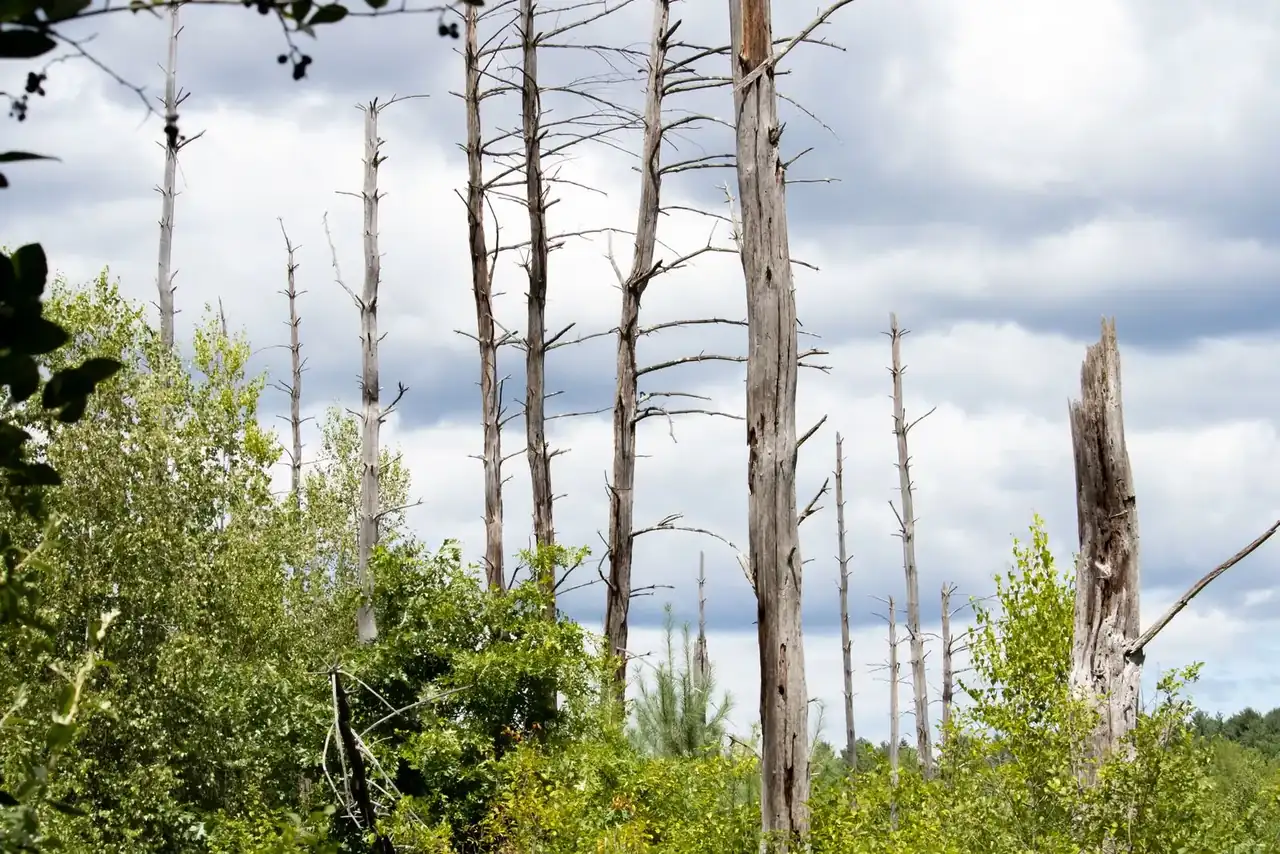
The reason bagworms matter more on evergreens than on deciduous trees comes down to how the two grow back. A honeylocust or a hackberry stripped by an insect in June will push a second flush of leaves and be fine. An eastern redcedar, a spruce, or a juniper does not have dormant buds along the defoliated stems in the same way, and heavily defoliated branches often stay bare permanently.
Winter is the other opportunity and it costs nothing. The bags are visible on bare branches and on evergreen foliage once the weather turns, and pulling them off by hand removes next year's eggs. On a small juniper hedge that is a genuinely effective control. On a forty foot spruce it is not practical, which is when the June application earns its money.
- Treatment timed to larval emergence, roughly mid June in Douglas and Shawnee counties
- Hand picking bags over winter removes the eggs before they hatch
- Evergreens frequently do not recover from heavy defoliation
- Deciduous trees usually push a second flush and recover
Iron chlorosis on pin oak and maple
Yellow leaves with green veins is the pattern. It shows up most on pin oak and on maple in this area, and it is not a disease and not an insect. Kansas soils run alkaline, and at high pH iron binds up in forms the tree cannot take in. The iron is in the ground. The tree simply cannot reach it.
General fertilizer does not fix this and can make the appearance worse by pushing new growth the tree cannot supply. What works is either an iron chelate applied to the soil in a form that holds at high pH, or a trunk injection that puts iron directly into the vascular system and bypasses the soil chemistry entirely.
Neither is permanent. The soil pH is not changing, so treatment repeats. A soil test before the first application is worth the small cost, because a tree that is yellowing from compaction, root damage, or waterlogged clay looks similar from thirty feet and does not respond to iron at all.
The Kansas tree pest calendar
This is the rough order things happen in Douglas and Shawnee counties. Seasons shift by a couple of weeks either direction depending on the spring, and we adjust to the year rather than to the calendar page.
The point of laying it out this way is that almost every item has a window, and almost every window is short.
- 1 Late winter: dormant oil on scale infested trees, and hand removal of bagworm bags
- 2 Late winter through early March: pruning on everything except oaks, which get their own dormant window
- 3 April through July: no oak pruning, because sap beetles carry oak wilt to fresh wounds
- 4 Spring through early summer: emerald ash borer trunk injections while the tree is moving water
- 5 Mid June: bagworm treatment on juniper, spruce, and redcedar, timed to larval emergence
- 6 Early summer: borer prevention on newly planted and drought stressed trees
- 7 Mid summer: watch for oak wilt symptoms and for canopy thinning that starts at the top of an ash
- 8 Late summer: pine wilt shows itself, and the removal gets scheduled for the following spring
- 9 Fall: deep root fertilization, soil tests, and planning next year's treatments
Borers, scale, and the trees that attract them
Most borers are secondary pests. They attack trees that are already stressed, which in Kansas usually means a tree planted too deep, a tree with a compacted or waterlogged root zone, a newly transplanted tree that never got watered properly, or a tree with construction damage from a few years back. Emerald ash borer is the notable exception, because it attacks healthy ash as readily as stressed ash.
That distinction changes the treatment. For a secondary borer, an insecticide alone treats the symptom while the tree keeps declining from whatever weakened it. Fixing the water, correcting a buried root flare, or relieving compaction does more than any spray. Newly planted trees and thin barked species like maple are worth protecting preventively during establishment.
Scale insects are the ones people miss entirely, because they do not look like insects. They read as bumps on twigs and stems, and the first thing most owners notice is sticky honeydew on a car parked underneath and black sooty mold growing on it. Scale is treatable, and the timing depends on when the crawler stage is active for that particular species.
Spray, soil, or injection, and what each costs
Three delivery methods, and the right one depends on the pest and the site. Foliar spray coats the outside of the plant and is the tool for things feeding on the surface, like bagworms. HomeGuide puts spray treatment at $60 to $80 per treatment and notes it is less effective and takes three to four visits a year.
Soil applications get taken up through the roots and work well on smaller trees with intact root systems. Trunk injection puts the product directly into the vascular system, which is the method for anything feeding under the bark and the method we prefer on properties with gardens, wells, ponds, or pollinator plantings, since there is no drift and nothing entering the soil. HomeGuide puts injection at $10 to $15 per inch of trunk diameter, or $75 to $250 per tree.
Not every problem needs a product. Anthracnose on sycamore looks alarming in a wet spring and the tree releafs and carries on. Cedar apple rust makes orange growths on redcedar that bother people considerably more than they bother the tree. We will tell you when the honest answer is to rake the leaves and wait.
Insect and Disease Control in progress
Representative of the work. Real job photography replaces these as the crews document jobs.
What this costs and how long it takes
$75 to $250 per tree for trunk injection, or $60 to $80 per foliar treatment with three to four visits a year
HomeGuide. Injection costs more per visit and works better than spraying.
These are published cost ranges for Kansas and national industry averages, not a quote. Every tree is different, and the only way to know what yours costs is a free on-site look.
What moves it up or down
- Hard access or a tight spaceadds 25 to 50 percent
- Several trees on one visitsaves 10 to 25 percent per tree
- Peak season, summer into falladds 10 to 20 percent
- A crane is requiredadds $500 or more
- Same-day emergencyup to two or three times standard rate
- Permit, where one is needed$60 to $450
Insect and Disease Control questions
When should bagworms be sprayed in Kansas?
Mid June, when the larvae are newly hatched and still feeding out in the open. Spraying later in the season hits a sealed bag and accomplishes nothing. If you missed the window, hand picking the bags off over winter removes next year's eggs and costs nothing but time.
My pin oak leaves are yellow with green veins. What is that?
Iron chlorosis. Our soils run alkaline and lock up iron the tree cannot take in. It is correctable with an iron chelate applied to the soil or with a trunk injection that bypasses the soil entirely, and it usually needs repeating because the soil pH is not changing.
Will my spruce grow back after bagworms stripped it?
Often not. Evergreens do not push a second flush from defoliated stems the way deciduous trees do, so heavily stripped branches frequently stay bare for good. A hackberry or a honeylocust in the same situation usually recovers within the season.
Is spraying safe around my kids, pets, and vegetable garden?
That is exactly why we prefer trunk injection where the pest allows it. Injection puts the product inside the tree with no drift and nothing entering the soil. Where a spray is genuinely the right tool, we tell you the product, the re-entry interval, and how long to keep the sprinklers off.
There is sticky stuff all over my car under the tree. What is going on?
That is honeydew, which is excreted by aphids or scale feeding above. The black film that grows on it afterward is sooty mold living on the honeydew rather than attacking the car or the tree. Treat the insect and both go away.
Do I need a yearly treatment plan or just a one time visit?
Depends on the pest. Bagworms are a once a year June item. Scale may need a dormant oil application and a growing season follow up. Emerald ash borer is every two years. Iron chlorosis repeats indefinitely. We will tell you which of those you actually have rather than sell a blanket program.
Something is eating my tree but I cannot tell what. Should I just spray?
No. Spraying without a diagnosis is how people spend money treating drought stress. Send photos, or have someone look at it. A good share of the calls we get about pests turn out to be root problems, a buried root flare, or a watering issue.
Are the orange growths on my redcedar a problem?
Cedar apple rust. It looks dramatic on the cedar in a wet spring and does very little to it. The tree that suffers is the apple or crabapple nearby, which is where the other half of that fungus lives. If you have both on the property, that is the conversation worth having.
Can you treat trees in the middle of a drought?
Some treatments, yes. Others do more harm than good, because a tree short on water cannot move product around and pushing new growth on a stressed tree makes things worse. We will say when it is better to water thoroughly and treat next season.
Request a free estimate
Free, no obligation. We call back within 15 minutes.
Got it.
We call back within 15 minutes during business hours.
That did not send. Call and we will take it down over the phone.
(785) 550-0100Coverage
Lawrence, Topeka, and everything between
We run out of Lawrence and cover 14 towns across 5 counties. If your town is not pinned, call anyway. We are usually closer than you think.
- Home base
- Lawrence, KS
- Storm calls
- 24 / 7
Often booked together
Emerald Ash Borer Treatment
Protecting healthy ash trees from EAB, which is established across northeast Kansas.
Pine Wilt Treatment
Preventive treatment for Scots and Austrian pine, which pine wilt kills within a season.
Arborist Consultation
Time with a certified arborist to diagnose a problem or plan work on your trees.
More in Plant Health Care
- Tree Risk Assessment
- Arborist Consultation
- Emerald Ash Borer Treatment
- Pine Wilt Treatment
- Tree Fertilization and Deep Root Feeding
- Oak Wilt Treatment