Tree Care
Tree Removal in Lawrence and Topeka
Taking down a tree safely when it is dead, dying, or growing somewhere it cannot stay.
- Typical job
- One day for a single backyard tree
- Cheapest window
- Winter, when demand drops
- Average Lawrence tree
- About 40 feet tall
- Kansas licensing
- None required, so ask for insurance
What this is
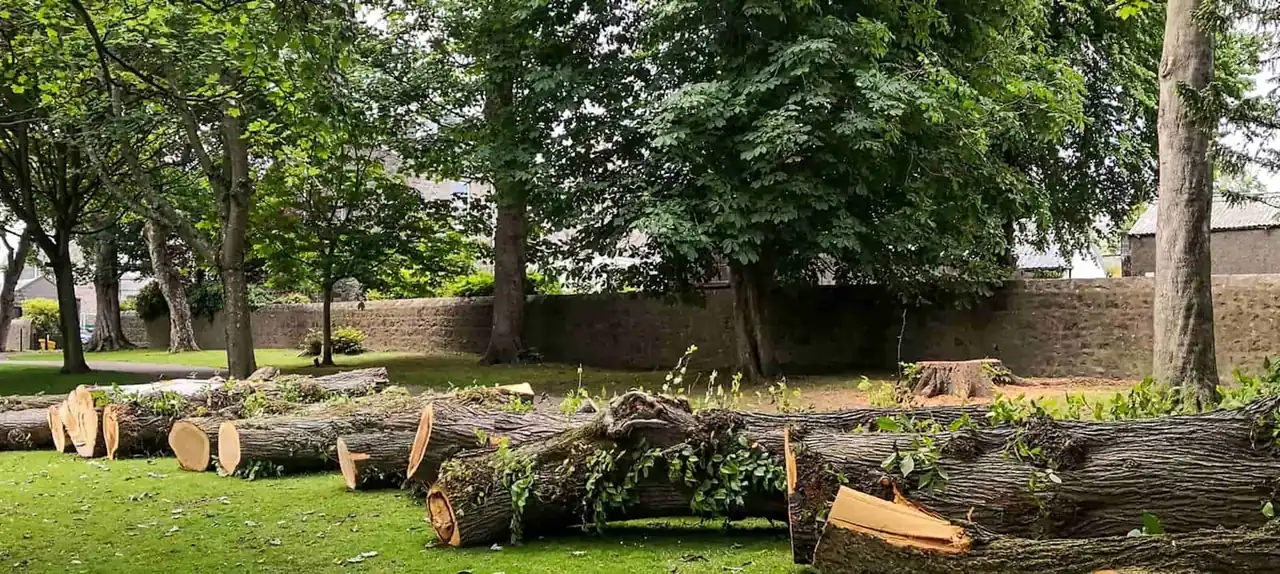
Most removals in Lawrence and Topeka are not about the tree. They are about what is underneath it. A silver maple in an open pasture comes down in an afternoon. The same tree six feet from a roofline, with a power drop running through the canopy, gets dismantled in pieces and lowered on ropes. We look at access before we look at the trunk, because access decides the method and the method decides the price.
What the job includes
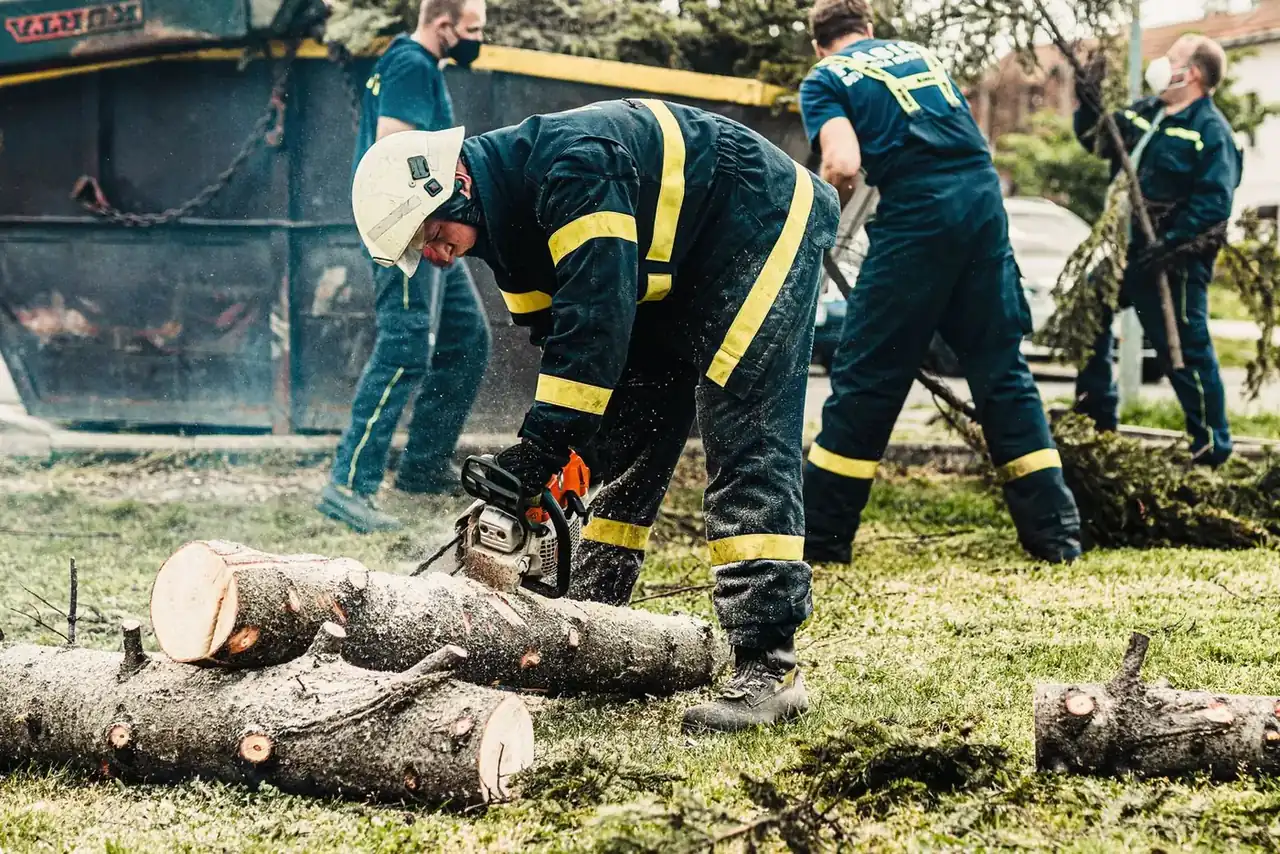
- Sectional dismantling for trees close to structures, fences, or overhead lines
- Crane and bucket work when climbing is not the safe option
- Plywood and ground protection mats over lawns and driveways
- Stump ground low as a separate line item, or left standing if you prefer
- Chips, limbs, and rounds hauled off unless you want the wood kept
Access decides the method, and the method decides the price
The first three measurements we take on a removal are the distance from the trunk to the nearest structure, the width of the tightest gate or side yard, and how far brush has to travel to reach the chipper. Those numbers set the method. A tree with truck access gets felled or dismantled into large pieces that hit the ground and get bucked. The same tree behind a six foot privacy fence in an East Lawrence backyard gets taken apart in small pieces, roped down, and carried out by hand, and the labor hours go up by a factor most homeowners do not expect.
Size matters in a way that is not linear. Doubling the trunk diameter roughly quadruples the cross sectional area, so a 24 inch bur oak is not twice the work of a 12 inch one, it is closer to four times the wood weight coming down through the same rigging. Angi puts difficult access alone at 25 to 50 percent more than an easy job, and that is on top of the size band, not instead of it.
When a tree cannot be climbed safely or the drop zone is occupied by a garage, we bring a crane. Angi puts the typical crane adder at around $500 for truck rental plus the extra staff, and Fixr prices a crane assisted removal on an 80 foot plus tree at $1,500 to $2,500. That sounds like a lot until you price the roof it is protecting.
- Trunk diameter measured at four and a half feet, plus overall height and crown spread
- Clear distance to the house, garage, deck, fence, and the service drop
- Gate width and turf conditions, since a wet Douglas County lawn in March will rut
- Drag distance from the tree to where the chipper can park
- Whether the wood is sound enough to climb, or dead enough to need a bucket or crane
The trees that come out around here, and why
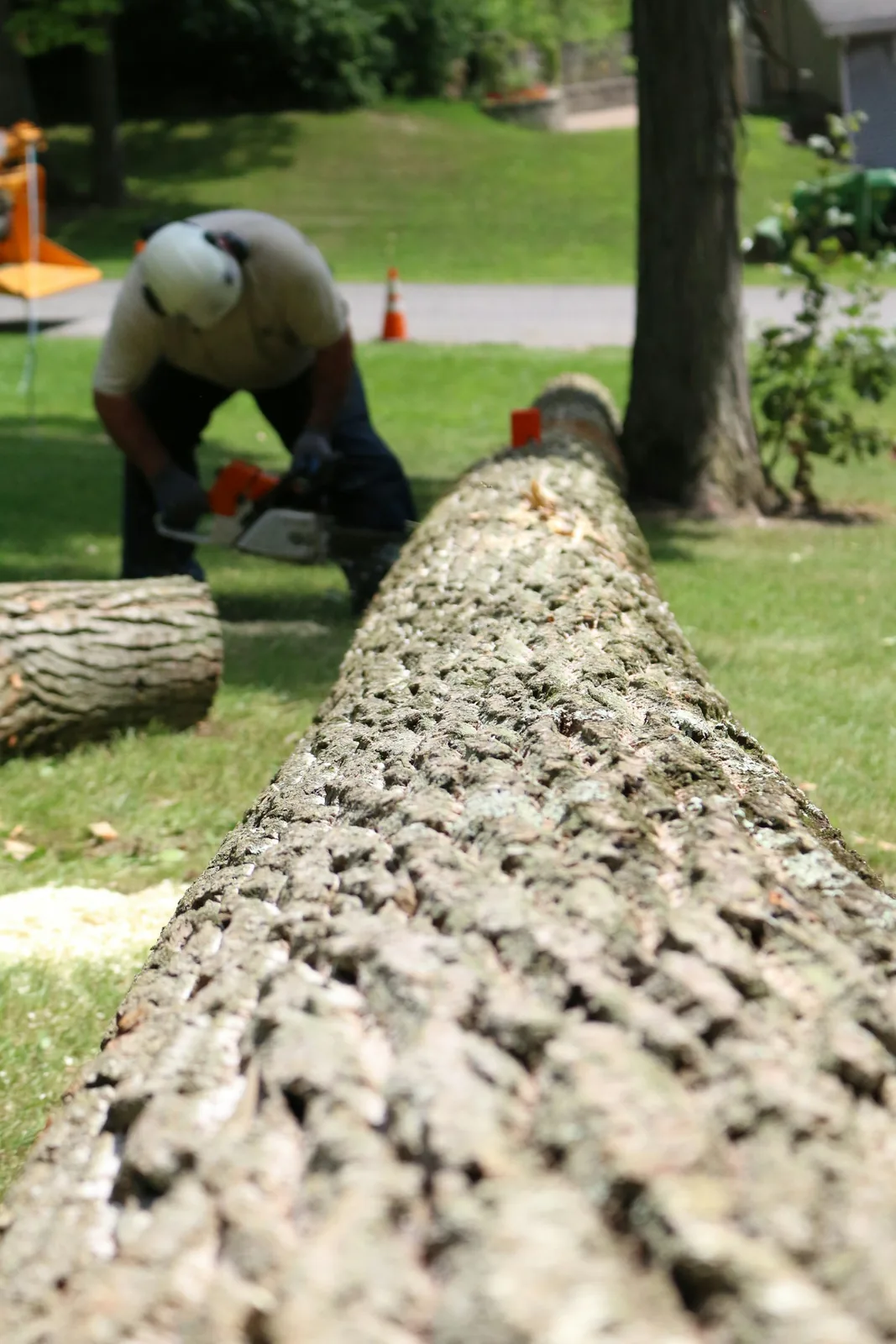
Green ash is the volume driver right now. K-State Research and Extension has emerald ash borer confirmed in 13 northeast Kansas counties, and an untreated ash in Douglas or Shawnee County is on a clock. Dead ash is the worst wood to work in the trade. It goes brittle within a season or two of dying, limbs snap under a climber instead of bending, and a tree that would have cost one number standing green costs a different number once it needs a bucket truck. Removing ash early is cheaper than removing ash late, and that is not a sales line, it is a rigging problem.
Scots pine is the other scheduled removal. Pine wilt turns a mature Scots pine brown in a few weeks in late summer, and K-State is specific about the sanitation step: a dead tree has to come down and be chipped or burned before May 1, because the pine sawyer beetles carrying the nematode hatch out of standing dead wood and move to the next tree in the windbreak.
The rest are structural. Silver maple and Siberian elm were planted everywhere in Topeka and Lawrence in the postwar decades, both grow fast, and both hold weak branch unions. Kansas Forest Service rates 59 percent of the Kansas urban tree canopy as fair to poor, naming silver maple, elm, and pin oak as the aging and declining dominants. Cottonwood along the Kansas River bottom drops limbs the size of a normal tree. Osage orange is fine standing in a hedge row and a problem standing over a driveway.
How a removal day actually runs
The sequence below is what a crew does on a standard residential removal. It varies with the tree, but the order does not, because each step depends on the one before it.
You do not need to be home for any of it. Most homeowners leave a gate unlocked and come back to a cleared yard.
- 1 We walk the site, measure the tree, identify the targets underneath it, and quote it in writing before anything is scheduled.
- 2 Utilities get sorted. The service drop to your house is ours to work around. Primary lines on the poles belong to Evergy and have to be de-energized or covered by their crew first, and we make that call rather than leaving it to you.
- 3 Vehicles come out of the driveway, plywood or ground protection mats go down anywhere a machine crosses turf, and the drop zone gets cleared and roped off.
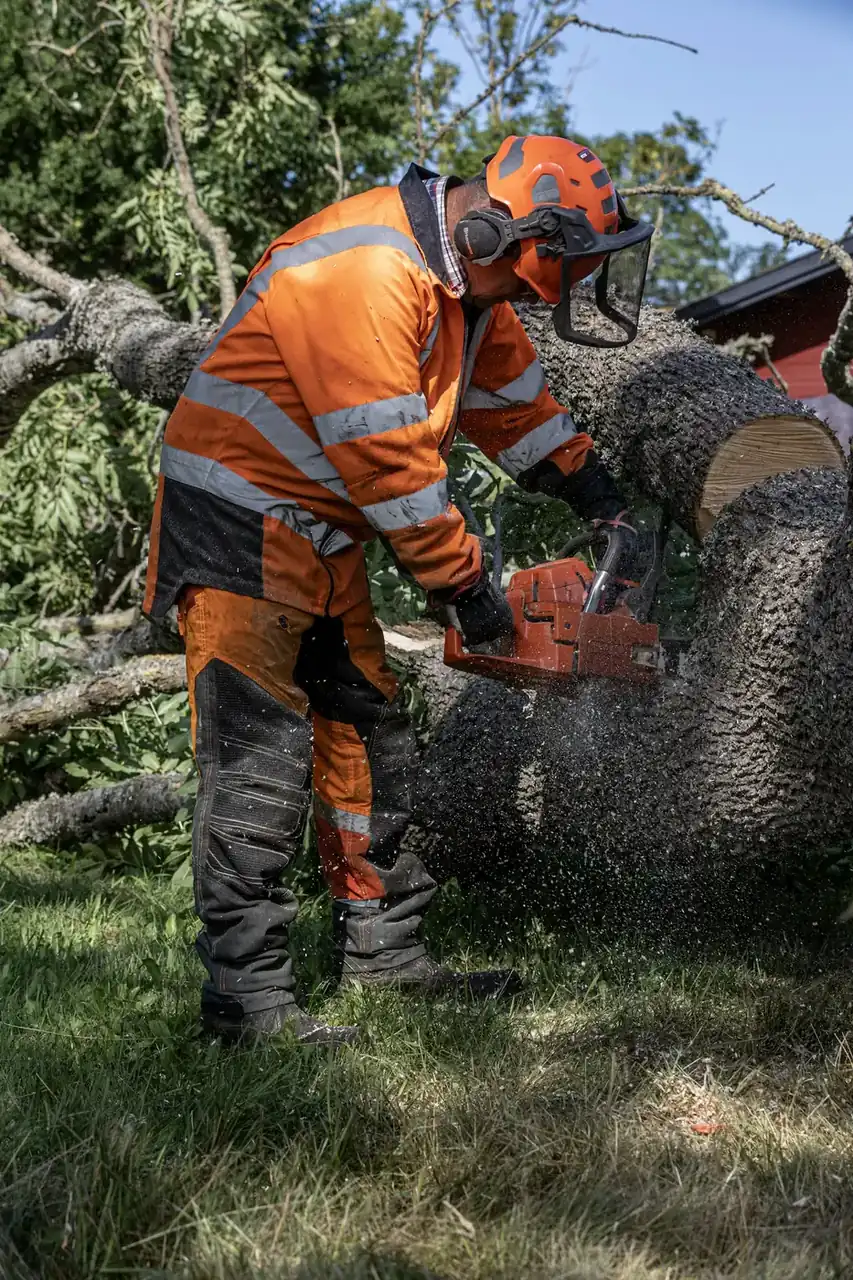
- 4 The climber or bucket operator takes the canopy apart from the top down, limb by limb. Anything that cannot free fall gets rigged and lowered on a friction device rather than dropped.
- 5 The trunk comes down in sections sized to what the ground crew and the loader can handle, or in one piece if there is genuinely room for it.
- 6 Brush goes through the chipper on site. Rounds get loaded out, or cut to firewood length and stacked if you told us you burn.
- 7 The stump gets ground if you booked it, then the whole work area gets raked and blown down before the trucks leave.
What removal costs in Lawrence and Topeka
The honest version is that no company can quote your tree from a web page, and every published national average is measuring something different. Angi, This Old House, and HomeGuide all agree closely on the size bands even where their headline averages disagree by more than double. Small trees under 30 feet run roughly $200 to $500. The 30 to 60 foot band, which is where most of this market sits, runs roughly $450 to $1,200. Sixty to 80 feet runs roughly $800 to $1,500, and anything over 80 feet starts around $1,000 and goes up from there.
Kansas figures land toward the lower half of that. Today's Homeowner reports an average tree removal of $472 in Lawrence and $527 in Topeka. Those same city profiles put the average Lawrence tree at 40 feet and 66 years old, and the average Shawnee tree at 43 feet, which is the single most useful fact for budgeting here. The typical northeast Kansas job is a medium tree, not a monster.
The counterweight is worth stating. Wellnitz Tree Care, a certified operator with offices in both Topeka and Lawrence, publishes prices by trunk diameter that run well above the aggregators: $500 to $2,000 for a 7 to 12 inch tree, $900 to $3,000 for 13 to 20 inches, and $2,000 and up past 21 inches. They put an average large removal around $3,000. The gap is not dishonesty on either side. Aggregator averages include easy small trees with hazards excluded, while a real quote on a real tree near a real house is a different job.
- Multiple trees on one visit cut the per tree cost 10 to 25 percent, per HomeGuide
- HomeGuide puts peak summer and fall demand at 10 to 20 percent higher than the off season
- Angi puts hard access at 25 to 50 percent above an open yard removal
- Our price includes hauling brush and logs off the property unless you ask us to leave the wood
Kansas does not license tree companies, so check these instead
There is no state license to remove trees in Kansas. Today's Homeowner states it plainly in its Kansas market data, and it changes what a homeowner should be asking for. Anybody with a pickup and a saw can print a card and knock on doors after a storm, and in Douglas and Shawnee counties they do, usually within 48 hours of a wind event.
The two documents that actually protect you are a certificate of general liability insurance and a certificate of workers compensation, both issued by the insurer directly rather than handed to you as a photocopy. Without workers comp, an injured groundman in your yard becomes your problem. Ask for both before anyone ties into a rope on your property.
Certification is the other filter. ISA certification and Kansas Arborists Association membership are voluntary here, which is exactly why they are worth asking about. Neither one guarantees a good job, but both require somebody to have studied and to keep studying.
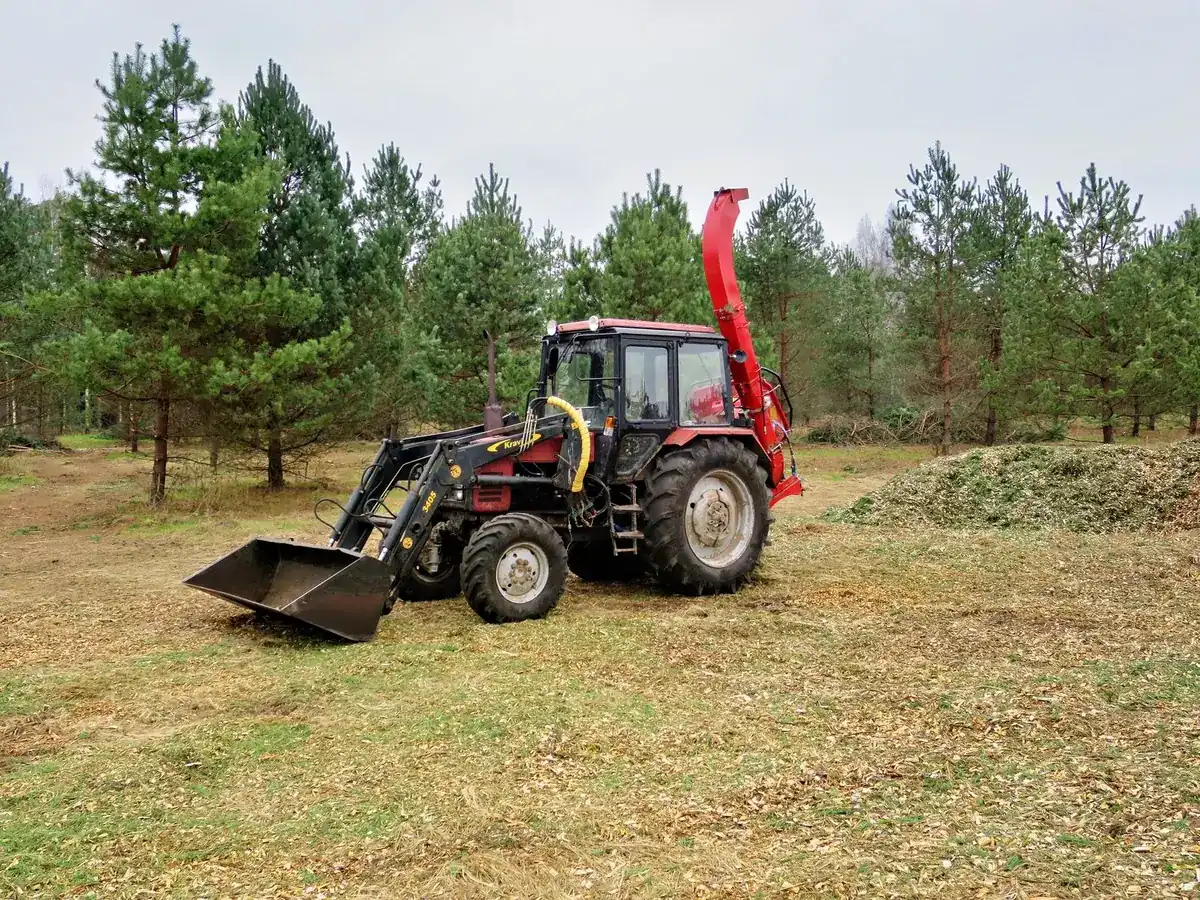
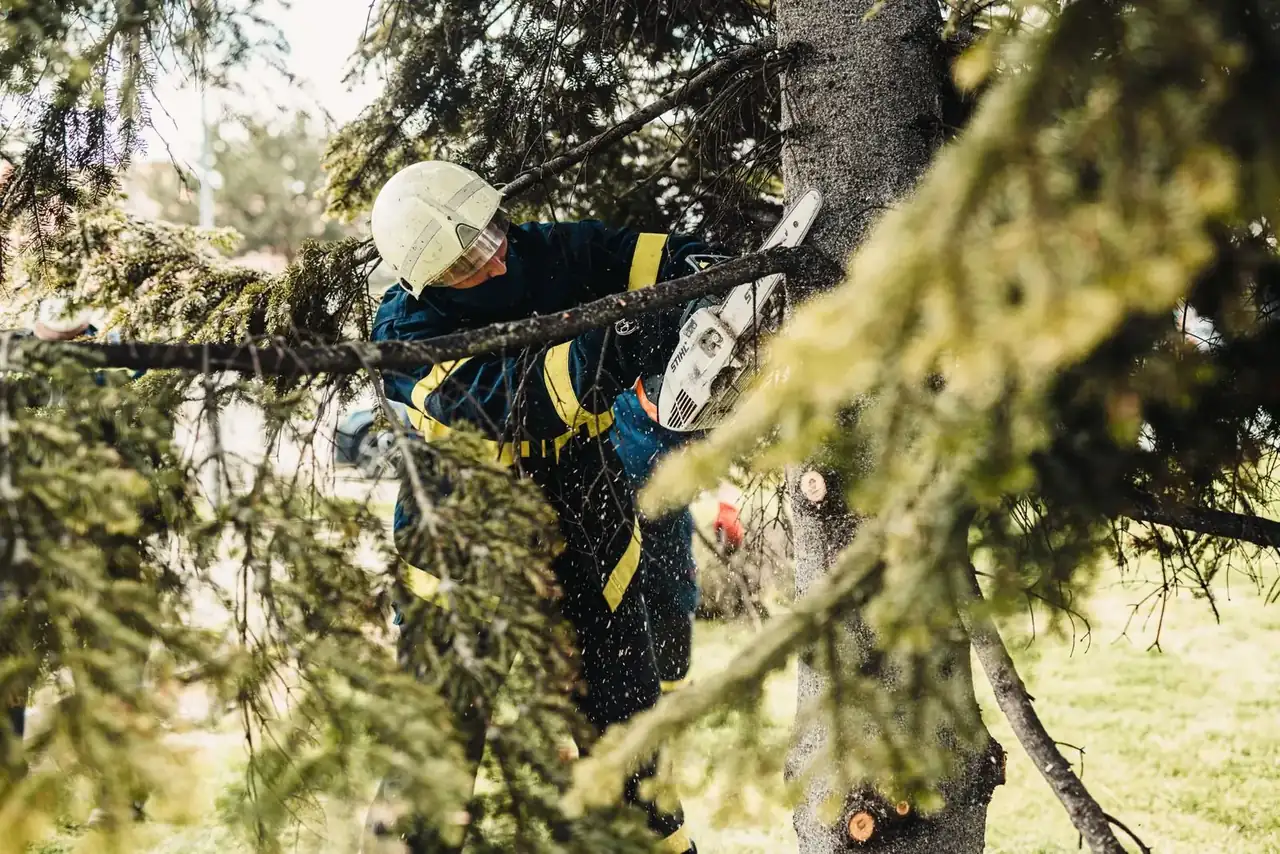
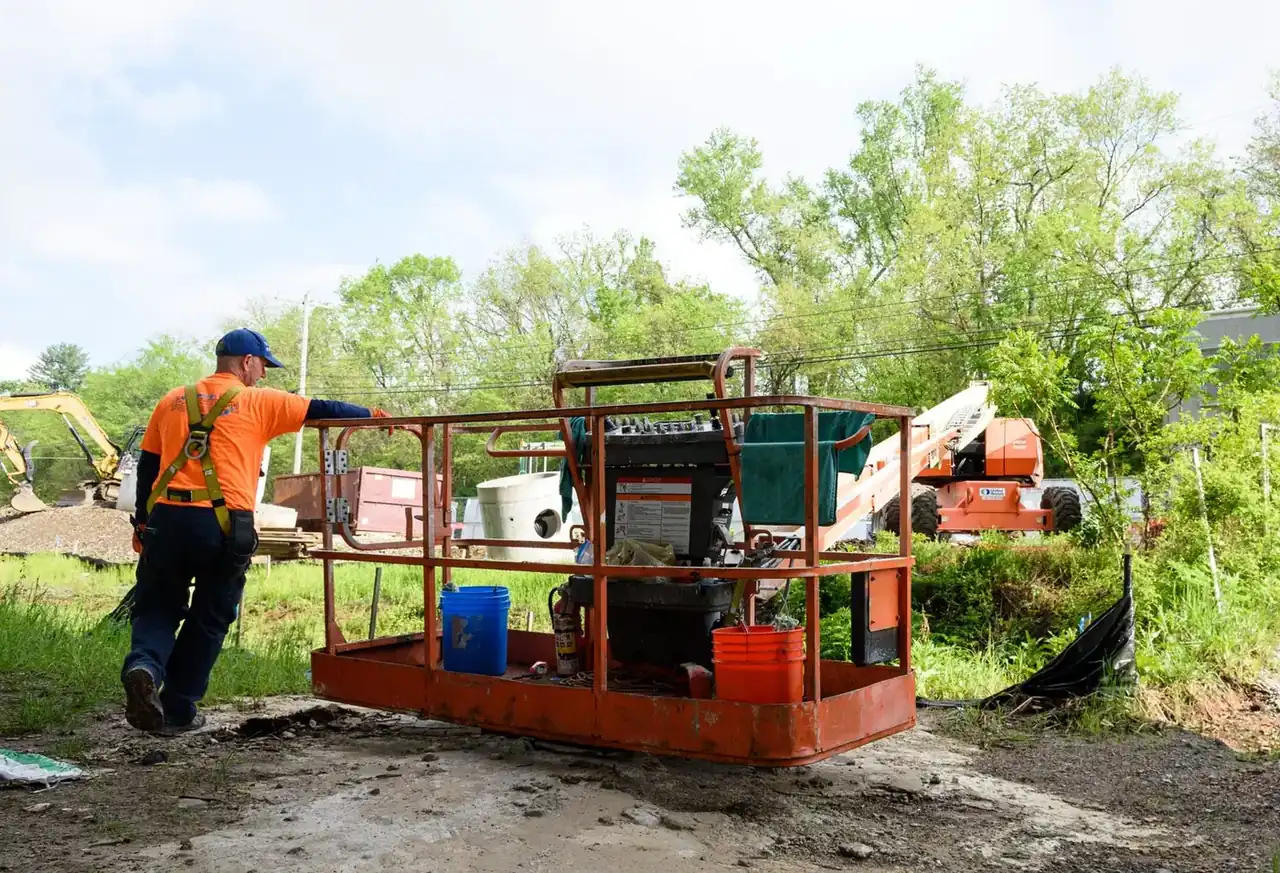
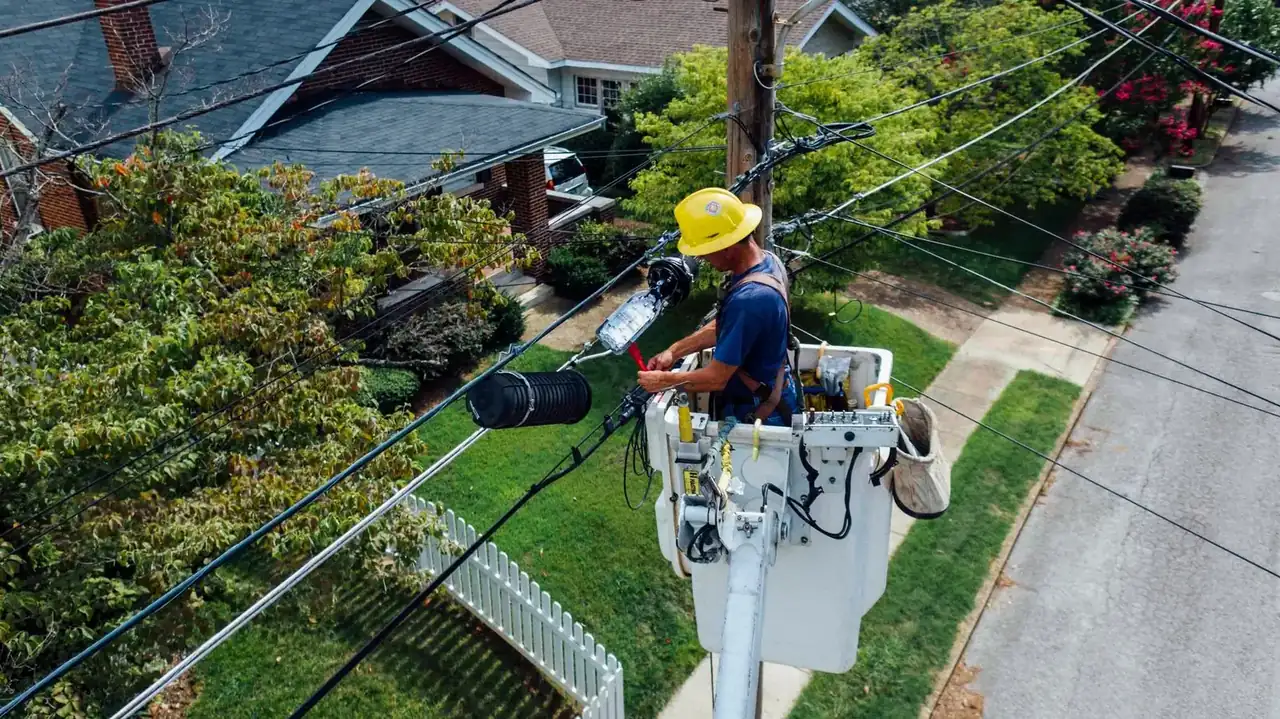
Tree Removal in progress
Representative of the work. Real job photography replaces these as the crews document jobs.
What this costs and how long it takes
Most removals run $450 to $1,200 for a 30 to 60 foot tree, $200 to $500 for something small, and $1,000 to $2,500 for anything over 80 feet
ProMatcher Kansas, Angi, This Old House and HomeGuide all bracket these ranges. Most trees we take down in Lawrence and Topeka fall in that 30 to 60 foot band.
These are published cost ranges for Kansas and national industry averages, not a quote. Every tree is different, and the only way to know what yours costs is a free on-site look.
What moves the price
- Height and trunk diameter
- How close the tree is to a house, garage, fence, or power line
- Whether a truck and chipper can reach the tree or everything has to be carried out
- Whether the stump is ground and how deep
- Condition of the tree, since dead wood cannot be climbed and needs a crane or bucket
Included
- Full removal to the stump
- All limbs, brush, and rounds hauled away
- Rake and blow down of the work area
Quoted separately
- Stump grinding, quoted separately so you can skip it
- Hauling the ground stump chips off site
- Repair or replacement of turf under the drop zone on very large removals
What moves it up or down
- Hard access or a tight spaceadds 25 to 50 percent
- Several trees on one visitsaves 10 to 25 percent per tree
- Peak season, summer into falladds 10 to 20 percent
- A crane is requiredadds $500 or more
- Same-day emergencyup to two or three times standard rate
- Permit, where one is needed$60 to $450
Estimates are free and you do not need to be home. We walk the property, take measurements, and send the quote the same day.
Tree Removal questions
What is the average price to have a tree taken down?
There is no single trustworthy average, and anyone quoting you one from a web page is guessing. The national cost guides disagree by more than double on that exact number. Fixr publishes an average of $435 while This Old House publishes $906. What they do agree on is the size bands. Under 30 feet runs roughly $200 to $500, 30 to 60 feet runs roughly $450 to $1,200, 60 to 80 feet runs roughly $800 to $1,500, and over 80 feet starts around $1,000. Where your tree lands inside its band comes down to access, what is underneath it, and whether the wood is sound.
How much does it cost to remove a tree in Kansas?
Kansas runs below the national midpoints. Today's Homeowner puts the average removal at $472 in Lawrence and $527 in Topeka, with a Shawnee average of $616. Those averages cover a lot of small trees. On the other end, Wellnitz Tree Care, a certified arborist firm with Topeka and Lawrence offices, publishes $500 to $2,000 for a 7 to 12 inch trunk and $900 to $3,000 for 13 to 20 inches, and puts a typical large removal near $3,000. Both are real. The aggregator averages describe easy trees with hazards excluded, and the operator prices describe trees standing next to houses.
How big of a tree to charge $1000 for removal?
In this market, roughly a 40 to 60 foot hardwood with a trunk somewhere in the 15 to 20 inch range and reasonable access. That sits at the top of the $450 to $1,200 dollar medium band that Angi and This Old House both publish, and inside Wellnitz Tree Care's $900 to $3,000 dollar range for a 13 to 20 inch trunk. Move the same tree behind a fence with a 200 foot brush drag and $1,000 stops covering it. Put it in an open pasture off a gravel drive and it comes in under.
Can seniors get trees removed for free?
Not as a standing program that we can point you to in Douglas or Shawnee County. Free removal generally happens in three situations. The tree is in the public right of way and belongs to the city rather than to you, the removal is covered by a homeowners insurance claim after the tree hit a structure, or a church group or volunteer organization takes it on as a one off. Be careful with anyone going door to door offering free or nearly free removal to older homeowners, because Kansas requires no license to do this work. If you are on a fixed income, tell us. We will tell you honestly whether the tree can safely wait a season and what the cheapest defensible version of the job looks like.
What is the cheapest time of year for tree removal?
Winter and very early spring. HomeGuide puts peak summer and fall demand at 10 to 20 percent above the off season, and that tracks with what happens here. Dormant trees carry no leaf weight, frozen or firm ground takes equipment without rutting, and crews have open calendar space in January and February that they do not have in September. The one exception is anything that has become a hazard. Waiting five months to save 15 percent on a tree leaning over a bedroom is not a saving.
Is a dead tree cheaper to remove than a live one?
Usually the opposite. Angi notes that poor tree health can add up to 15 percent to the final cost, and the mechanism is simple. Nobody climbs a dead tree. Once the wood has gone punky, the crew needs a bucket truck or a crane to reach the canopy, and equipment costs more than a climber with rope and saddle. Dead ash is the clearest case in northeast Kansas. Angi does note that a diseased tree with soft wood can sometimes come in lower, around $400 to $900, but that describes a small tree, not a mature one.
Will my homeowners insurance pay for the removal?
Generally only when the tree has damaged a covered structure. A healthy or dead tree standing in the yard is maintenance, and maintenance is on the owner. A tree that came down on the roof, the garage, or the fence is usually a claim. Policies differ, so read yours or call your agent. We photograph damage before and during the work, which is the documentation adjusters ask for.
Do I need a permit to take down a tree in Lawrence or Topeka?
Trees on private property are generally the owner's to manage in both cities. Street trees and anything in the public right of way fall under the city and are handled differently. National guides put permit fees, where they apply, at anywhere from $60 to $450. If your tree is anywhere near the curb line we check which side of the line it sits on before we quote, because that answer changes who is paying.
Request a free estimate
Free, no obligation. We call back within 15 minutes.
Got it.
We call back within 15 minutes during business hours.
That did not send. Call and we will take it down over the phone.
(785) 550-0100Coverage
Lawrence, Topeka, and everything between
We run out of Lawrence and cover 14 towns across 5 counties. If your town is not pinned, call anyway. We are usually closer than you think.
- Home base
- Lawrence, KS
- Storm calls
- 24 / 7
Often booked together
Stump Grinding
Grinding the stump below grade so you can mow over it, replant, or lay sod.
Emergency Tree Removal
A tree is on the house, across the drive, or leaning on a line. Call, do not fill out a form.
Tree Trimming
Clearing limbs off roofs, driveways, and power drops, and thinning canopies before storm season.
More in Tree Care
- Tree Trimming
- Tree Pruning
- Stump Grinding
- Stump Removal
- Crown Reduction
- Deadwooding
- Cabling and Bracing
- Tree Planting
- Shrub and Hedge Trimming
- Firewood