Tree Care
Stump Grinding in Lawrence and Topeka
Grinding the stump below grade so you can mow over it, replant, or lay sod.
- Typical job
- A couple of hours for one stump
- Standard depth
- 6 to 12 inches below grade
- Gate needed
- About 36 inches
- Extra stumps
- Much cheaper on the same visit
What this is
A stump grinder is a wheel of carbide teeth that chews the stump into chips. We grind 6 to 12 inches below grade for turf, deeper if you are replanting in the same hole. The chips go back in the hole by default because that is what most people want, though they settle over the following year and usually need topping up with soil.
What the job includes
- Ground 6 to 12 inches below grade for mowing, deeper for replanting
- Surface roots ground out along with the stump where they run
- Chips backfilled into the hole, or hauled off if you want clean soil
- Access checked first, since a grinder needs roughly a 36 inch gate
What the machine is doing down there
A stump grinder is a spinning wheel studded with carbide teeth, swept side to side across the stump a few inches at a time. It does not pull anything out. It converts the stump into a pile of chips mixed with soil, working down and outward until the wood is below the depth you asked for. On a 20 inch hackberry with clean access that is often a 30 minute job. On a 36 inch Osage orange it is not, because Osage orange is one of the hardest woods in North America and it eats teeth.
Depth is a decision, not a default. Six to 12 inches below grade is right for turf, because it puts the remaining wood below anything a mower will ever touch and below the depth turf roots occupy. Replanting in the same hole needs more, closer to 18 inches, and even then the new tree usually goes in a few feet to the side rather than directly into the old root plate.
Surface roots get ground where they run. The radial roots flaring out from the stump are the ones that lift turf and catch mower decks, so they come out along with the stump. The deeper structural roots stay in the ground and decay over several years, which is fine for everything except a footing.
- 6 to 12 inches below grade for lawn, deeper for replanting
- Surface roots ground out to where they drop below mower depth
- Grindings backfilled by default, or hauled off if you want clean soil
- Hardwood species like Osage orange and bur oak take longer and cost more to grind
Access and buried utilities, which decide half these jobs
The standard machine needs roughly a 36 inch gate. Below that we bring a narrow unit, which fits through most residential gates but grinds slower, and slower shows up in the price. Before quoting a backyard stump we look at the gate, the slope between the gate and the stump, and whether there is a deck, an AC condenser, or a raised bed in the path.
Every stump grind gets a utility locate. Buried irrigation lines, invisible fence wire, gas service, and low voltage landscape lighting all live in the top foot of soil, which is exactly the layer a grinder works in. A locate is free and it takes a couple of business days, which is the main reason grinding is often scheduled a few days after the removal rather than the same afternoon.
Rock is the other variable. Parts of Douglas and Shawnee County have limestone close to the surface, and some older properties have rubble buried around old foundations and driveways. Teeth hitting rock wear in minutes rather than hours, and a stump sitting in fill full of concrete costs more to grind than the same stump in clean soil.
How a grind runs
Grinding is a short visit compared to a removal, usually a couple of hours on site including setup and cleanup for a single stump.
You do not need to be home. Access to the stump and an unlocked gate is all we need.
- 1 We measure the stump at its widest point above grade, including the root flare, since that is what the price is based on.
- 2 A utility locate goes in and we wait for the marks. Irrigation and invisible fence usually are not covered by the public locate, so tell us where yours run.
- 3 Loose rock, landscape edging, and anything breakable within throwing distance gets moved, and we set up plywood or shields where chips would otherwise blast siding, windows, or a vehicle.
- 4 The grinder works the stump in passes, sweeping the wheel across and stepping down a few inches at a time until it reaches the agreed depth.
- 5 Surface roots get chased out from the stump to the point where they drop below grade on their own.
- 6 Grindings go back into the hole and get raked level, mounded slightly, because they will settle. If you asked for clean soil instead, the grindings get shoveled out and hauled.
- 7 The area gets raked and blown down, and any chips thrown into beds or onto the drive get cleaned up.
What happens to the ground afterward
Grindings are wood, and wood decomposing in soil pulls nitrogen out of it while it breaks down. Grass seeded directly into a pile of grindings comes in thin, pale, and slow, and homeowners usually blame the seed. If you want lawn back over the spot, pull most of the grindings out, backfill with topsoil, and seed into that.
The hole settles. A stump hole backfilled with grindings will sink over the following six to twelve months as the material compacts and decays, sometimes by several inches. We mound it above grade on purpose. Plan to top it up with soil the following spring, which is a wheelbarrow of dirt rather than a service call.
Leftover grindings are useful mulch anywhere you want them, spread two to three inches deep in a bed and kept off the trunks of anything living. What they should not do is sit in a pile against a fence post or a foundation, where they hold moisture.
- Pull grindings out and backfill with topsoil before seeding grass
- Expect the hole to settle over the first year and plan to top it up
- Spare grindings make acceptable bed mulch, kept away from trunks
- Replanting goes a few feet to the side of the old stump rather than into it
What stump grinding costs
Two clusters show up in the data and both are real. Wellnitz Tree Care, a certified operator with Topeka and Lawrence offices, publishes $175 to $500 or more per stump. HomeGuide puts stump removal at $100 to $500 and up, Fixr at $100 to $500, and LawnStarter puts grinding specifically at $158 to $450. A small stump with easy access and grindings left in place sits at the bottom of that. A large hardwood stump with grindings hauled off sits at the top.
ProMatcher's Kansas contractor data publishes a per inch rate of $3.12 per linear inch of stump diameter, and it is worth understanding why we do not quote that way. Run the math on a 20 inch stump and it produces $62, which is below what it costs to hook up a trailer and drive across town. The per inch rate describes marginal grinding time, not a job. Every real quote includes a trip.
Additional stumps on the same visit are much cheaper than the first one, because the trip and setup are already paid for. Angi puts the first stump at $100 to $150 with additional stumps around 50 each, and HomeGuide confirms reduced pricing for additional stumps. If you have four stumps in a fence line, do them together.
- Diameter is measured at the widest point above grade, including the flare
- Depth, wood hardness, access, and buried rock are the other drivers
- Hauling the grindings off site is a separate line item
- Several stumps on one visit costs far less per stump than separate trips
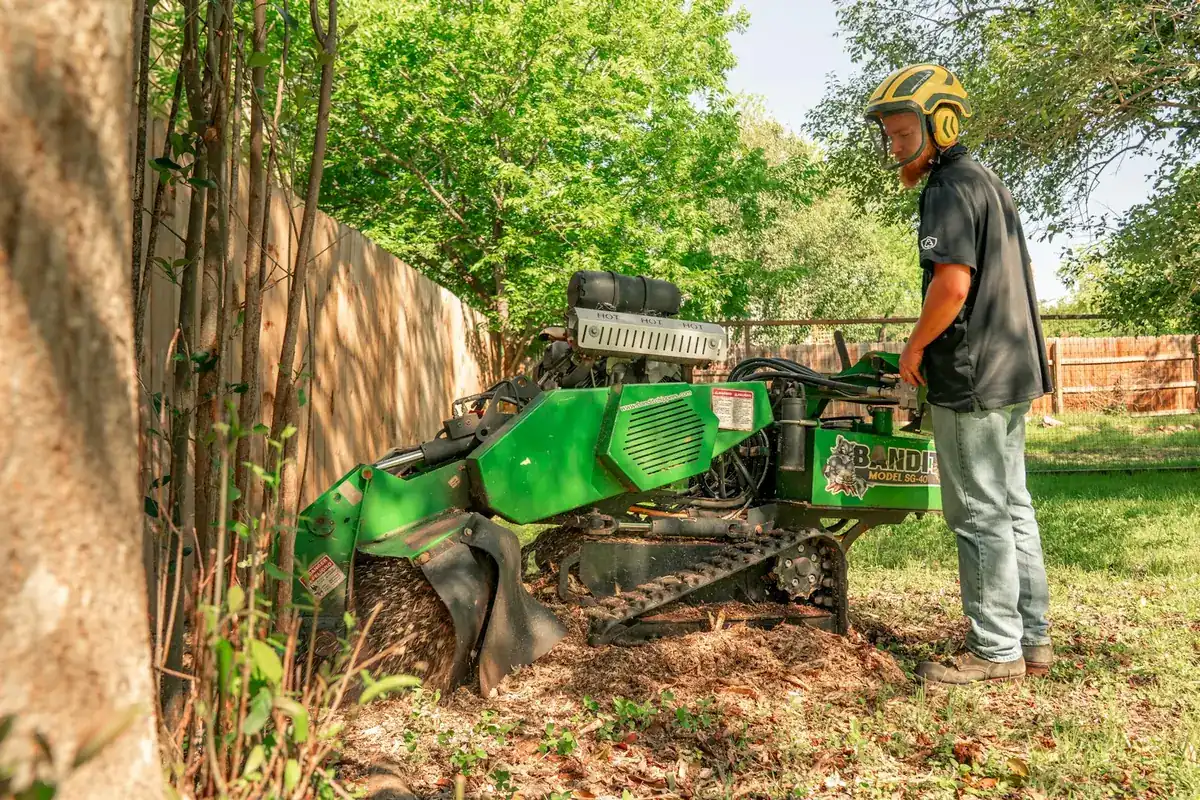
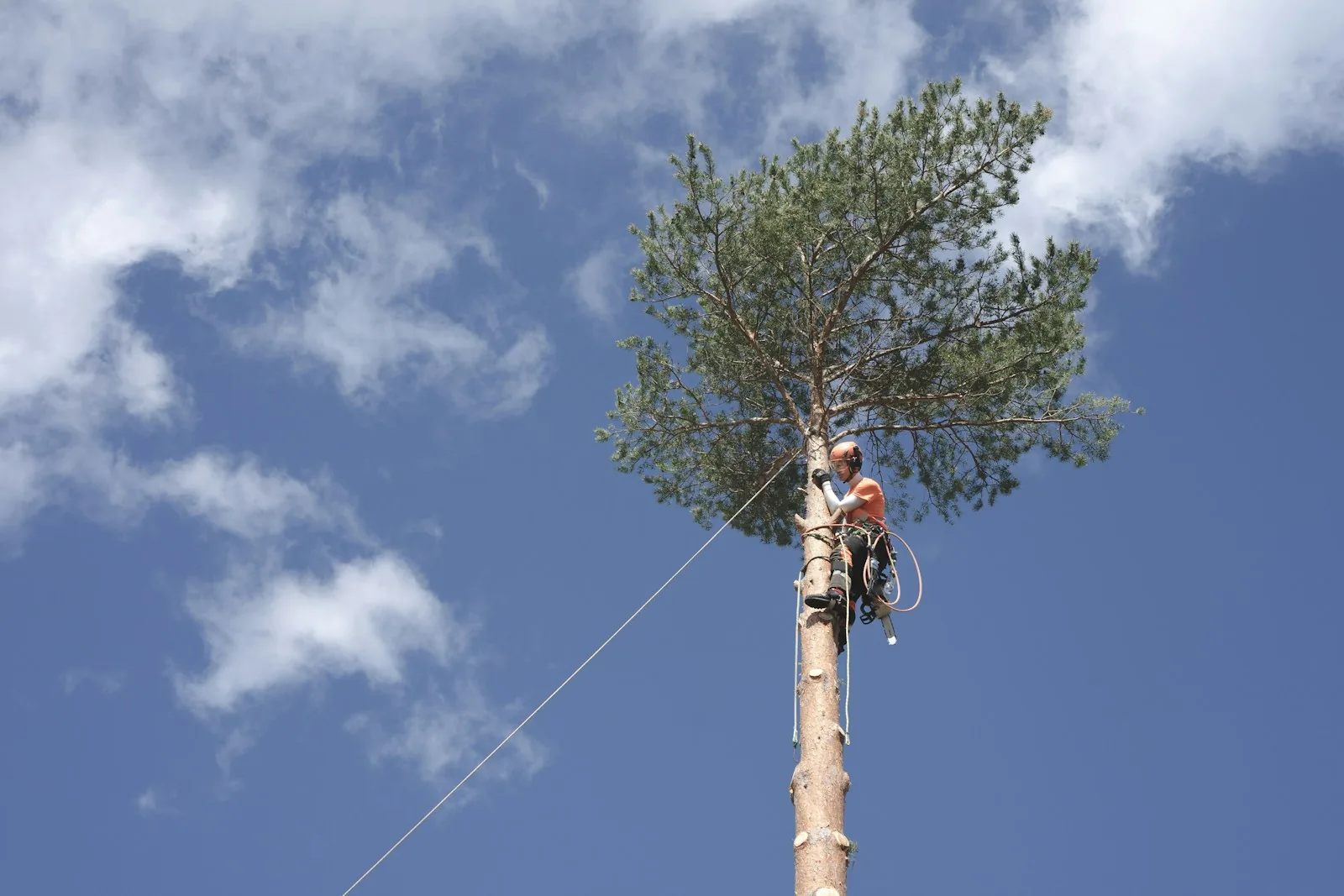
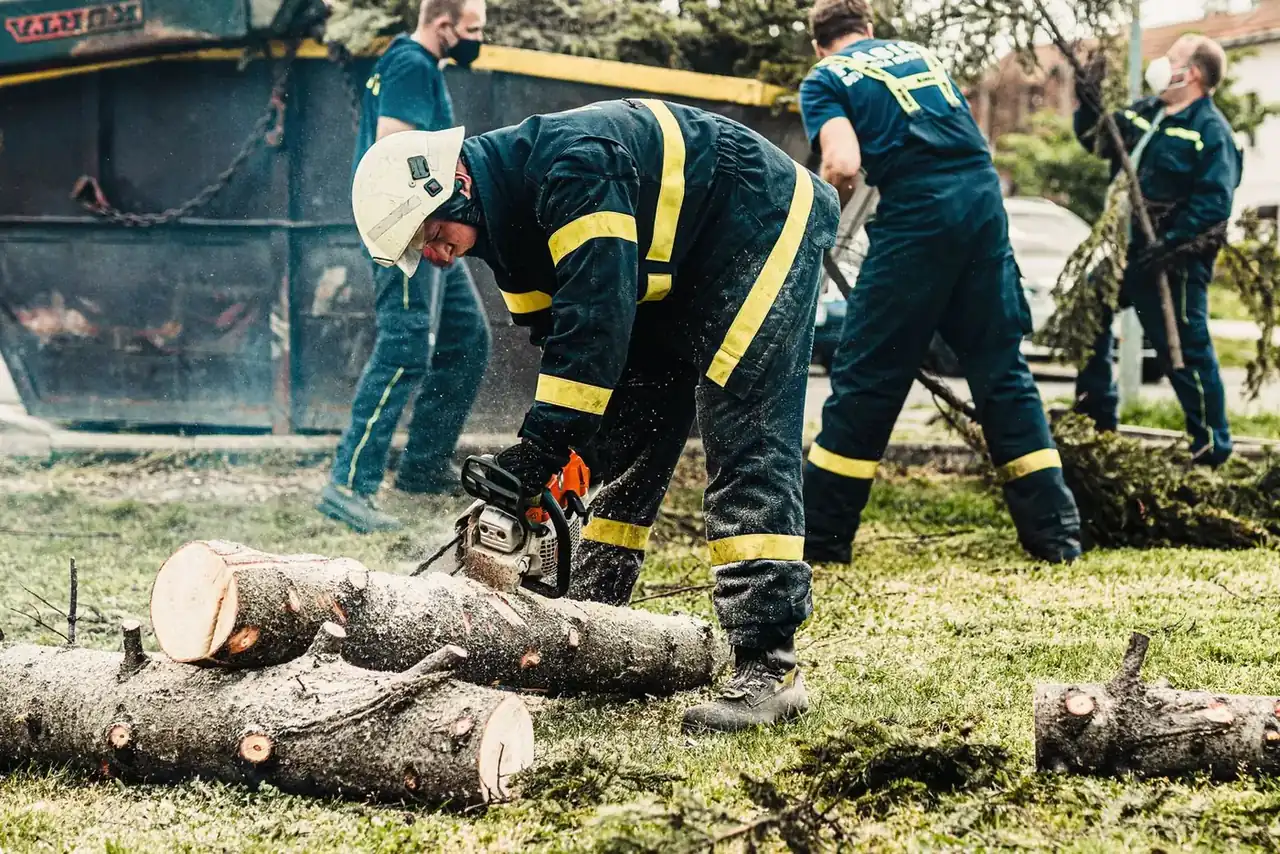
Stump Grinding in progress
Representative of the work. Real job photography replaces these as the crews document jobs.
What this costs and how long it takes
$150 to $400 for a typical single stump, with additional stumps on the same visit often $50 to $100 each
Two Kansas operators overlap here: Wellnitz Tree Care in Topeka and Lawrence publishes $175 to $500, and Kansas Tree Experts publishes $125 to $375.
These are published cost ranges for Kansas and national industry averages, not a quote. Every tree is different, and the only way to know what yours costs is a free on-site look.
What moves the price
- Stump diameter measured at the widest point above grade
- How deep it needs to go, turf versus replanting
- Access, since a gate narrower than 36 inches means a smaller and slower machine
- Whether the chips stay or get hauled
- Rock and debris in the soil, which wears teeth fast
Included
- Grinding to the agreed depth
- Chips raked back into the hole
- Cleanup of the surrounding area
Quoted separately
- Hauling chips off site
- Topsoil and seed or sod
What moves it up or down
- Hard access or a tight spaceadds 25 to 50 percent
- Several trees on one visitsaves 10 to 25 percent per tree
- Peak season, summer into falladds 10 to 20 percent
- A crane is requiredadds $500 or more
- Same-day emergencyup to two or three times standard rate
- Permit, where one is needed$60 to $450
We can usually quote a stump from a photo and a tape measure reading if you would rather not schedule a visit.
Once the chips are out and the hole is backfilled, that patch needs seed or sod to blend back into the lawn. Clean Cut Lawn Care handles that side, and shares our ownership.
Stump Grinding questions
What is the average price to have a tree taken down?
There is no reliable single average. The national guides disagree by more than double on that figure, with Fixr publishing $435 and This Old House publishing $906. The size bands are the useful part and they line up across sources. Under 30 feet runs roughly $200 to $500, 30 to 60 feet runs $450 to $1,200, 60 to 80 feet runs $800 to $1,500, and over 80 feet starts around $1,000. Grinding the stump is quoted separately from all of that, because it is a different machine and a different visit.
How much does it cost to remove a tree in Kansas?
Today's Homeowner puts the average removal at $472 in Lawrence, $527 in Topeka, and $616 in Shawnee. Wellnitz Tree Care, a certified firm with offices in both Topeka and Lawrence, publishes by trunk diameter instead, at $500 to $2,000 for 7 to 12 inches and $900 to $3,000 for 13 to 20 inches. Add stump grinding on top of whichever applies. Wellnitz publishes $175 to $500 or more per stump for the Topeka and Lawrence market.
How big of a tree to charge $1000 for removal?
Roughly a 40 to 60 foot hardwood with a 15 to 20 inch trunk and truck access. That is the top of the $450 to $1,200 dollar medium band published by Angi and This Old House, and it falls inside Wellnitz Tree Care's $900 to $3,000 dollar band for a 13 to 20 inch trunk. If the $1,000 dollar quote you are holding includes stump grinding on a tree that size, read it twice, because grinding on a 20 inch stump is normally a separate few hundred dollars.
Can seniors get trees removed for free?
Not through any standing program we can point you to in Douglas or Shawnee County. Free removal generally means one of three things: the tree belongs to the city because it sits in the right of way, an insurance claim is covering it because the tree hit a covered structure, or a volunteer group has taken it on. Kansas requires no license for tree work, so treat unsolicited door to door offers of free removal with suspicion. If cost is the constraint, leaving the stump standing rather than grinding it is the easiest few hundred dollars to save.
What is the cheapest time of year for tree removal?
Winter. HomeGuide puts peak summer and fall demand at 10 to 20 percent above the off season. Stump grinding is less seasonal than removal, though frozen ground in deep winter can slow a grinder and very wet spring ground means a machine will rut the lawn getting to the stump. Late winter and early fall are the easiest windows for grinding specifically.
How soon after the tree comes down can you grind the stump?
As soon as the utility locate clears, usually a couple of business days. There is no benefit to waiting for a stump to age, and there is a real cost to waiting a year, since suckers and volunteer growth around the stump make more work. Most people book both at once and take the grind a few days after the removal.
Do I have to grind the stump at all?
No. A stump left standing is not dangerous, it is just in your way. It will decay on its own over many years, and it will host fungi and carpenter ants along the way, which is a nuisance rather than a threat to a healthy tree nearby. The reasons to grind are mowing, replanting, and appearance. The reason not to is that it costs money you may want to spend elsewhere.
Will the grinder damage my lawn or driveway?
The machine tracks or rolls across turf to get to the stump, so on soft ground after rain it will leave marks. We lay plywood on the approach and we will reschedule rather than rut a soaked lawn. Chips throw hard while grinding, so we shield anything close, but expect to find some chips in the nearest bed regardless. We rake and blow the area before leaving.
Request a free estimate
Free, no obligation. We call back within 15 minutes.
Got it.
We call back within 15 minutes during business hours.
That did not send. Call and we will take it down over the phone.
(785) 550-0100Coverage
Lawrence, Topeka, and everything between
We run out of Lawrence and cover 14 towns across 5 counties. If your town is not pinned, call anyway. We are usually closer than you think.
- Home base
- Lawrence, KS
- Storm calls
- 24 / 7
Often booked together
Stump Removal
Excavating the stump and root ball out entirely when grinding is not enough.
Tree Removal
Taking down a tree safely when it is dead, dying, or growing somewhere it cannot stay.
Tree Planting
Choosing and planting species that survive Kansas clay, wind, and heat.
More in Tree Care
- Tree Removal
- Tree Trimming
- Tree Pruning
- Stump Removal
- Crown Reduction
- Deadwooding
- Cabling and Bracing
- Tree Planting
- Shrub and Hedge Trimming
- Firewood