Tree Care
Cabling and Bracing in Lawrence and Topeka
Steel hardware that supports a weak union or a heavy limb, so a tree worth keeping can stay.
- Inspection interval
- Every 3 to 5 years
- Anchor placement
- Two thirds up from the union
- Best paired with
- End weight reduction
- Not suitable for
- Trunk decay or root plate damage
What this is
A mature bur oak with a split down the middle of a co-dominant union is usually a removal. Sometimes it is a cable. Cabling puts a flexible steel connection high in the canopy that limits how far the two stems can move apart in wind. Bracing puts a threaded rod through the union itself. Neither is permanent and both need inspecting every few years, which is the part most companies do not mention when they install them.
What the job includes
- Cable installed in the upper canopy to limit movement at a weak union
- Through-rod bracing for unions that have already begun to split
- Limb support for long horizontal branches carrying too much end weight
- Inspection built into the plan, since hardware needs checking every 3 to 5 years
What the hardware is doing
A cable is a flexible steel connection installed high in the canopy, typically about two thirds of the way from the weak union to the top of the stems it is joining. It does not hold the tree up. It limits how far apart two stems can travel in a wind gust, which caps the peak stress at the union underneath. Every bit of movement below that limit is still allowed, because a tree that cannot move at all stops building the reaction wood that keeps it strong.
A brace is different hardware for a different problem. It is a threaded steel rod driven through the union itself and secured on both sides, and it resists the two stems pulling apart or twisting relative to each other. Bracing is used where a union has already begun to split, usually in combination with a cable rather than instead of one.
The two problems these fix are the ones that dominate mature trees in Topeka and Lawrence. A co-dominant union with included bark, where two stems press together rather than joining, and a long horizontal limb carrying too much weight at the far end. Kansas Forest Service rates 59 percent of the state's urban canopy fair to poor, naming aging silver maple, elm, and pin oak, which is a fair description of exactly the population that ends up cabled.
- Cables limit movement at a weak union without immobilizing the tree
- Braces resist a union that is already separating
- Placement is roughly two thirds up from the union, not at the union
- Limb support cabling for long horizontal branches carrying end weight
Which trees are worth the hardware
A cable is worth installing when the tree has real value and one identifiable defect. A bur oak in a front yard that has been there longer than the house, with a single co-dominant union and otherwise sound wood and a sound root plate, is exactly the case. Replacing that tree is a fifty year project and the hardware is a fraction of a removal.
It stops making sense when there is more than one thing wrong. Significant trunk decay, a compromised root plate, more than about a third of the canopy dead, or a union that has already split most of the way down cannot be solved by steel. Cabling a tree with a rotten base moves the failure point rather than removing it.
Cabling is also frequently the wrong first move on its own. Reducing the end weight on the stems above a weak union lowers the load the union sees, and doing that first often means the cable is doing less work for the rest of its life. On most trees we quote reduction and cabling together, because they address the same defect from opposite ends.
- One identifiable defect on an otherwise sound tree is the right case
- Trunk decay or a compromised root plate rules it out
- End weight reduction usually pairs with the cable rather than competing with it
- Common on mature bur oak, pin oak, silver maple, and hackberry here
How an installation runs
This is precision work in the upper canopy and it takes a full assessment before anyone drills anything. The location of the anchor points determines whether the system does what it is supposed to.
Every system gets documented, because hardware installed and forgotten is worse than no hardware at all.
- 1 The tree gets assessed first. We inspect the union, sound the trunk for decay, look at the root collar, and decide whether hardware is appropriate at all.
- 2 Anchor points get located roughly two thirds of the distance from the defective union to the top of the stems, in sound wood clear of other defects.
- 3 The stem diameter at each anchor determines the hardware size, since a cable rated below the load it will see is worse than useless.
- 4 Anchors get installed, either drilled through the stem with forged eyebolts or with a dead end hardware system chosen for the tree, and the cable gets tensioned so it is snug without pulling the stems together.
- 5 Where a union is already separating, a threaded brace rod goes through the union itself and gets secured on both faces.
- 6 Any end weight reduction agreed in the plan gets done at the same visit, since the climber is already in position.
- 7 We photograph the installation, record the locations and hardware sizes, and set the inspection date, which is three to five years out.
The inspection nobody mentions when they sell you a cable
Steel hardware in a living tree is not a permanent fix and it is not maintenance free. The tree keeps growing. Stems get thicker, the load on the cable changes, and the anchor points slowly get swallowed by new wood growing around them. Hardware sized correctly for a 14 inch stem is undersized for the same stem at 20 inches.
The inspection interval is three to five years. What we are looking at is the tension, whether the anchors have started to embed, whether the cable is still in sound wood, whether new defects have appeared, and whether the load case has changed because the canopy grew. Most inspections result in nothing being done, which is the correct outcome and still worth the visit.
A cable that nobody has looked at in fifteen years is not doing what the installer promised, and it may be actively hiding a problem. If you bought a house with cables already in the trees and you have no idea when they went in, get them looked at before the next storm season rather than after.
- Inspect every 3 to 5 years without exception
- Anchors embed as the stems grow around them
- Load changes as the canopy above the cable expands
- Hardware inherited with a house should be inspected before the next storm season
Cost and what it does not buy you
HomeGuide's arborist guide is the only source with editorial standards that prices this work, at $200 to $350 per tree, and it notes that cabling matters most in high wind areas. That figure looks low to us for a multi cable system in a large storm damaged oak, and no Kansas specific cabling price is published anywhere. We quote it after looking at the tree.
What the money buys is a reduced likelihood of one specific failure at one specific union under normal loading. It does not buy a safe tree. A cabled tree in a genuinely severe wind event can still fail, and it can fail somewhere other than the union you paid to protect. Anyone who tells you a cable guarantees the tree is selling.
The comparison worth running is against the removal cost of the same tree plus the cost and the decades of a replacement. Against a mature bur oak removal, which Wellnitz Tree Care puts in the range where large removals average around $3,000 in this market, a cable plus periodic inspection is usually the cheaper path for as long as the tree stays otherwise sound.
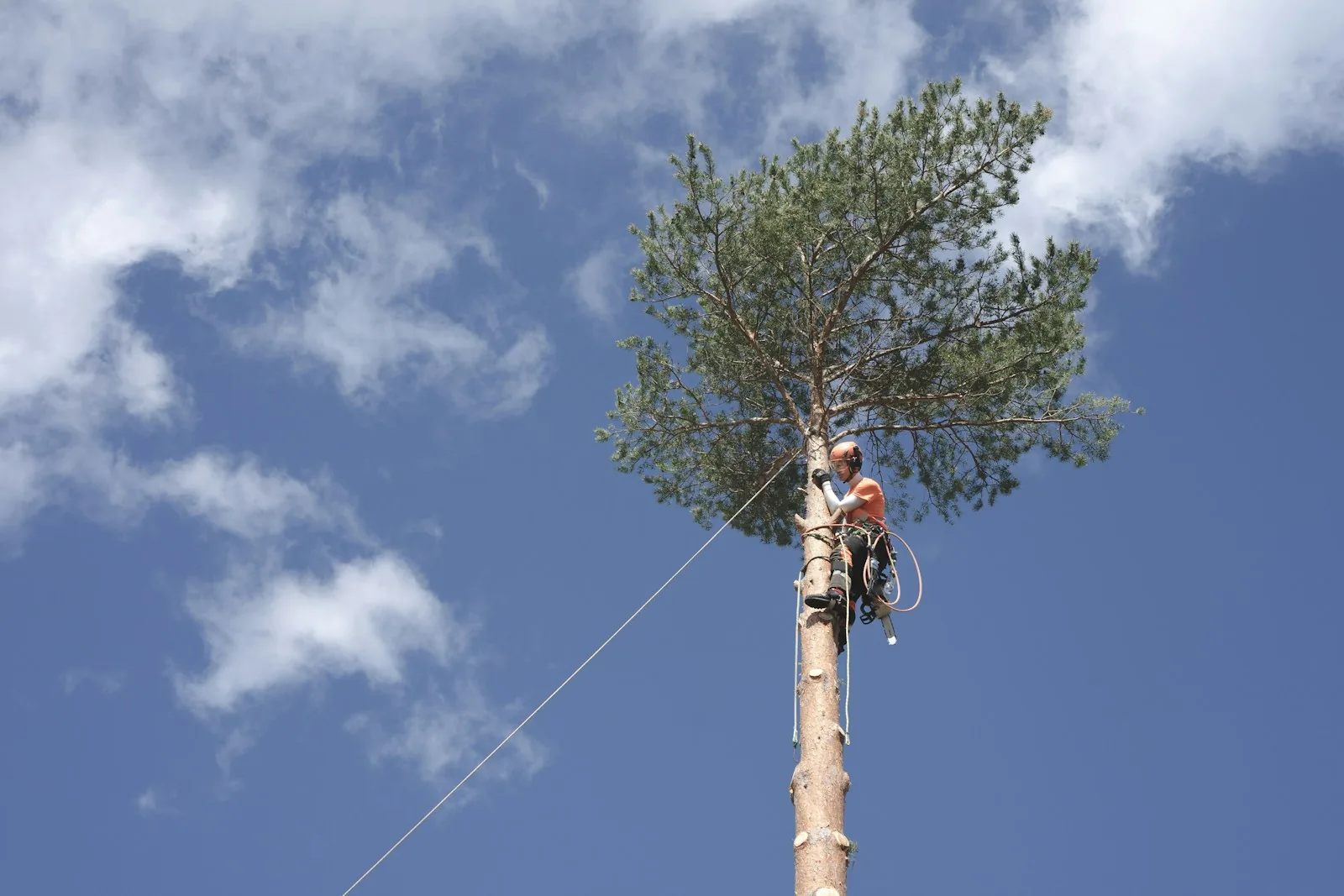
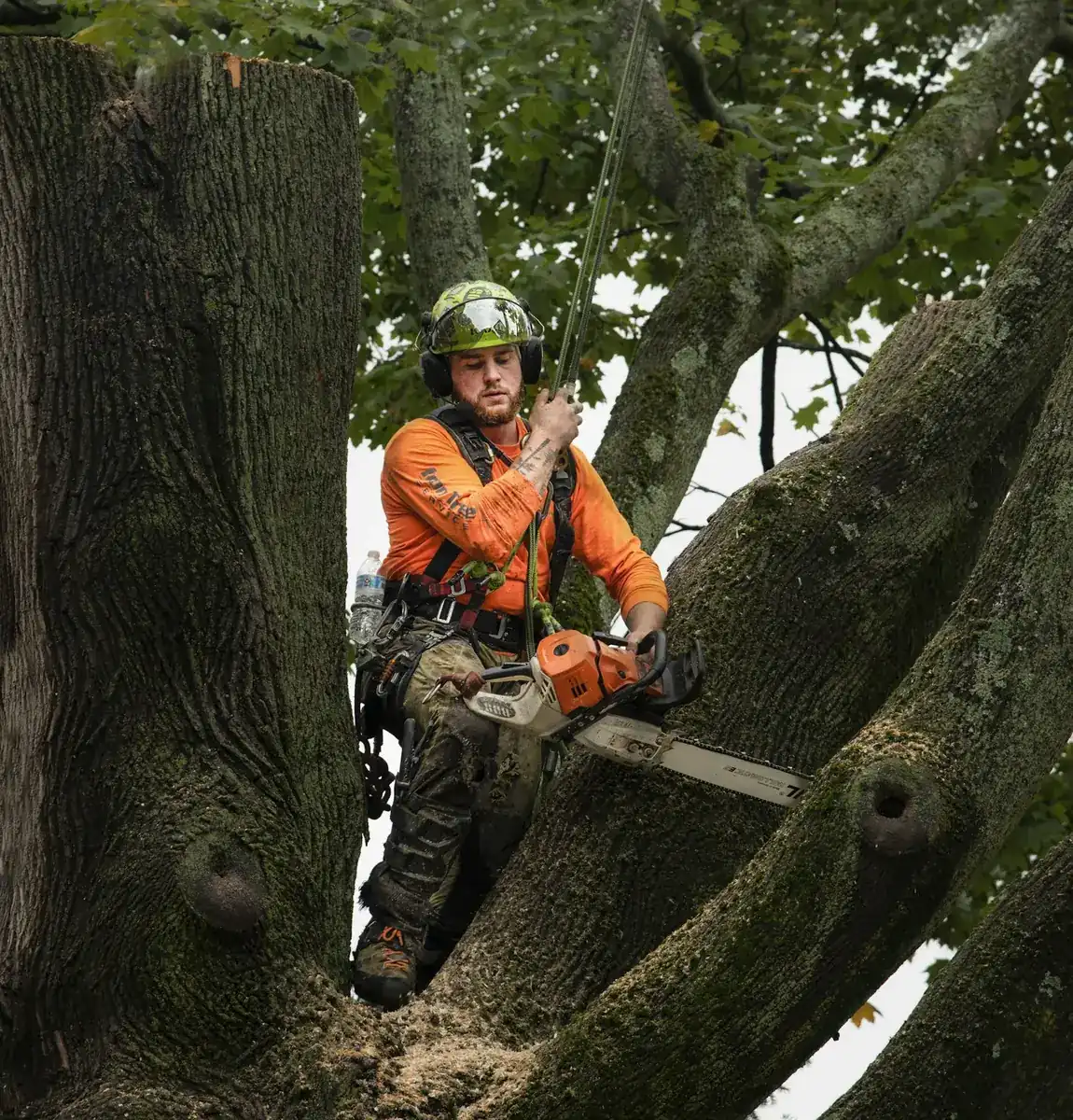
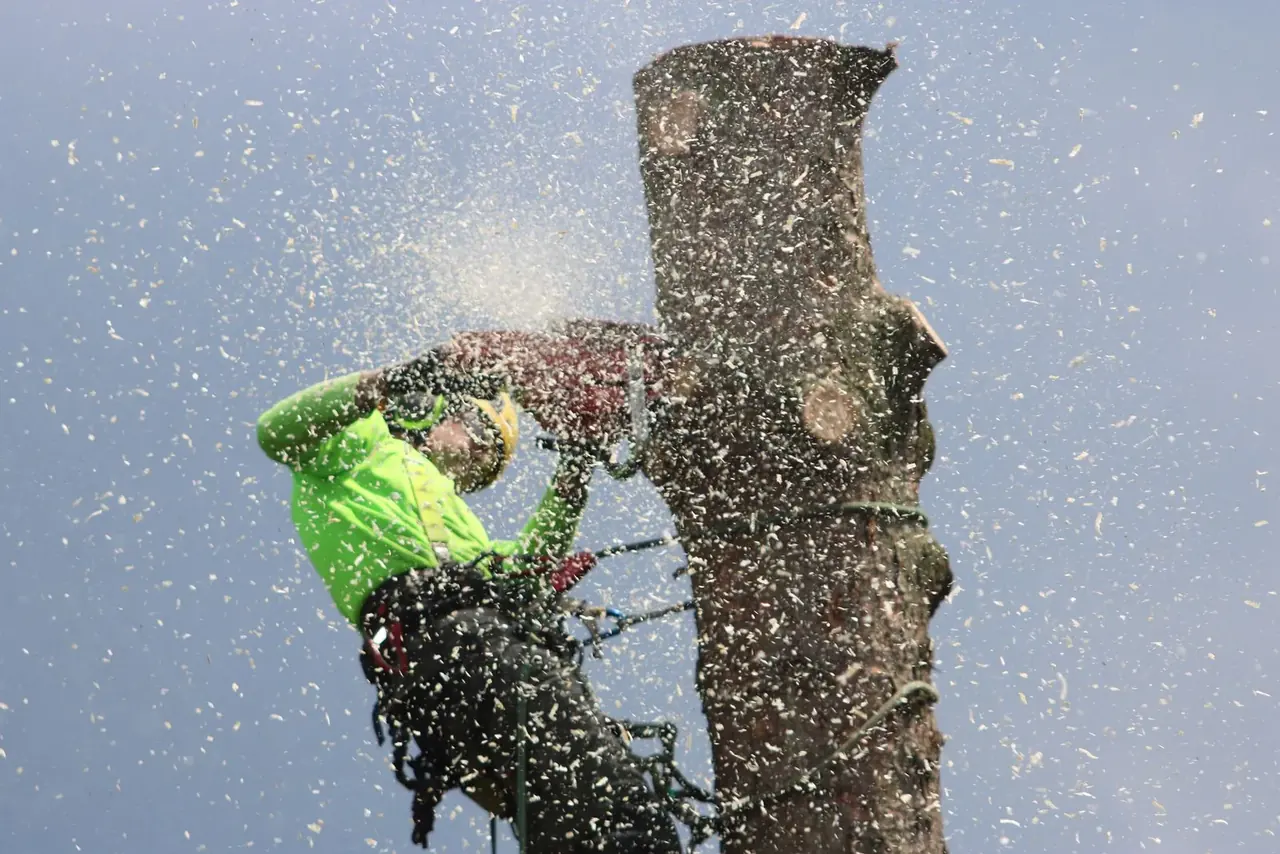
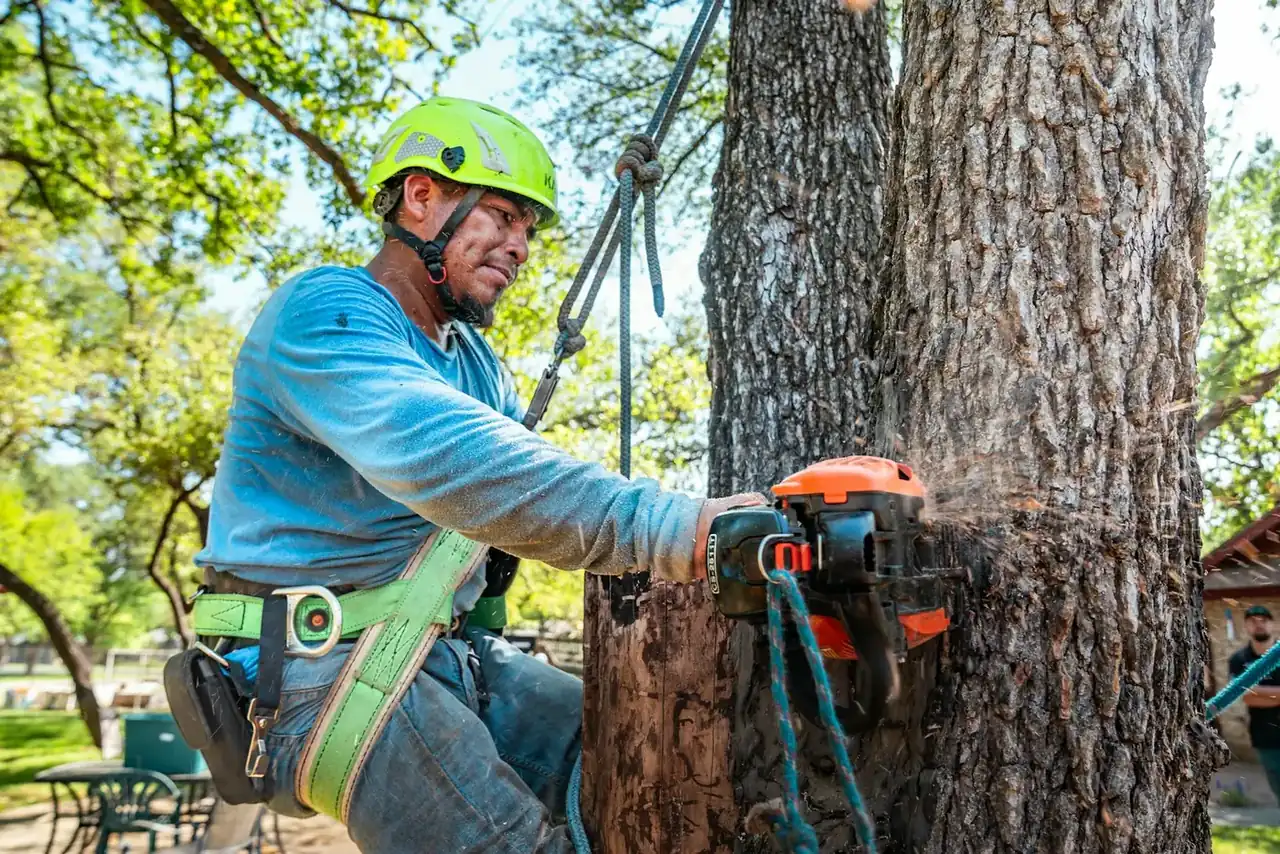
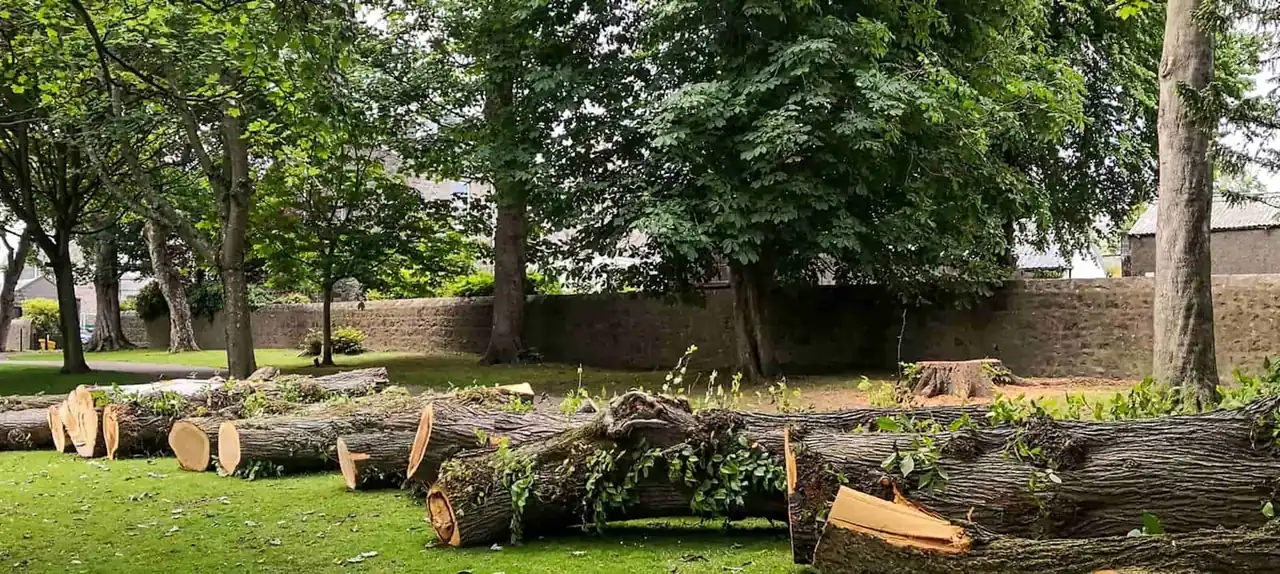
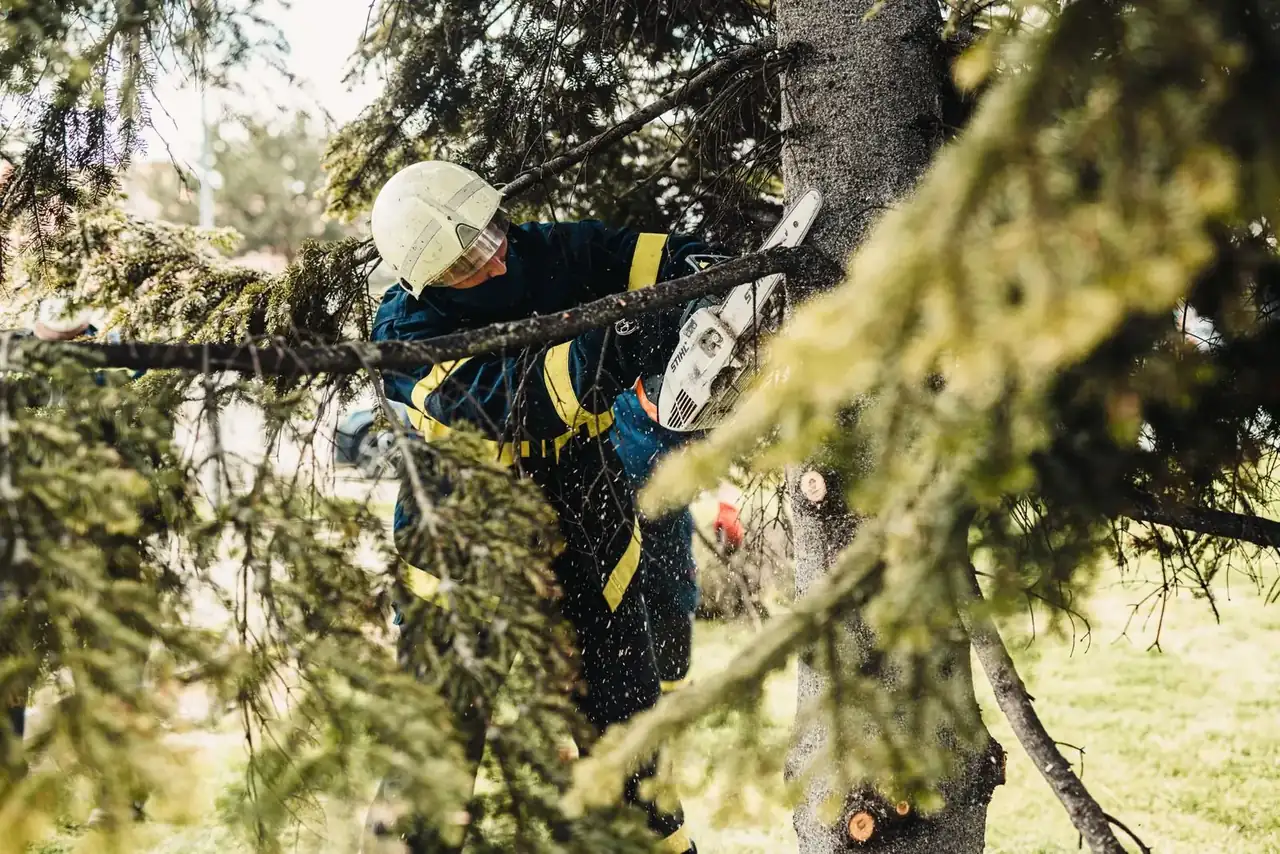
Cabling and Bracing in progress
Representative of the work. Real job photography replaces these as the crews document jobs.
Cabling and Bracing questions
How much does cabling a tree cost?
HomeGuide's arborist guide, the only editorially standard source that prices it, puts tree cabling at $200 to $350 per tree and notes it matters most in high wind areas. That figure is national and it looks low for a multi cable system in a large mature oak. There is no published Kansas number for cabling at all, so we quote it after inspecting the tree rather than from a table.
Where in the tree does the cable actually go?
Not at the weak union. It goes roughly two thirds of the distance from that union up toward the tops of the stems it is joining, anchored into sound wood clear of other defects. Placing it high is what gives it the mechanical advantage to limit movement at the union below. A cable installed low, close to the fork, does very little and puts hardware into the part of the tree least able to take it.
Does cabling guarantee my tree will not fail?
No, and anyone who says otherwise is selling. Cabling reduces the likelihood of one specific failure at one specific union under normal loading. It does not make the tree safe in every load case, it does not address decay elsewhere, and it does not help if the root plate lets go. It is a risk reduction tool with a defined scope.
Will the hardware hurt the tree?
The drilled anchor holes are wounds and the tree compartmentalizes them the same way it does a pruning cut. On a sound stem in good health that is not a meaningful cost. What does hurt a tree is a cable tensioned so tight that the stems cannot move at all, because trees build reaction wood in response to movement. The cable is set snug, not rigid.
My tree already has a split. Is it too late?
Depends how far it has run and what the trunk below it looks like. A union that has started to separate but is still mostly intact, on a tree with sound wood underneath, is a candidate for a brace rod through the union plus a cable above it. A union split most of the way down to the trunk, or a trunk with decay under the split, is a removal. That determination needs somebody looking at the tree, not a photograph.
I bought a house with cables already in the trees. What should I do?
Get them inspected before the next storm season. Hardware installed by a previous owner with no record of when or by whom is the most common version of this problem we see. We check tension, whether the anchors have embedded, whether the cable is still in sound wood, and whether the tree has developed new defects since. Most of the time the answer is that it is fine, which is worth knowing.
Is cabling cheaper than removing the tree?
For a mature tree that is otherwise sound, usually yes, and the gap is wide. Wellnitz Tree Care, working the Topeka and Lawrence market, puts an average large removal around $3,000 and prices trees over 21 inches in diameter at $2,000 and up. Against that, hardware plus an inspection every few years is modest. The calculation flips the moment the tree develops a second serious defect.
Request a free estimate
Free, no obligation. We call back within 15 minutes.
Got it.
We call back within 15 minutes during business hours.
That did not send. Call and we will take it down over the phone.
(785) 550-0100Coverage
Lawrence, Topeka, and everything between
We run out of Lawrence and cover 14 towns across 5 counties. If your town is not pinned, call anyway. We are usually closer than you think.
- Home base
- Lawrence, KS
- Storm calls
- 24 / 7
Often booked together
Tree Risk Assessment
A written evaluation of whether a specific tree is likely to fail, and what to do about it.
Crown Reduction
Bringing a tree down in height and spread without topping it, when it has outgrown its spot.
Arborist Consultation
Time with a certified arborist to diagnose a problem or plan work on your trees.
More in Tree Care
- Tree Removal
- Tree Trimming
- Tree Pruning
- Stump Grinding
- Stump Removal
- Crown Reduction
- Deadwooding
- Tree Planting
- Shrub and Hedge Trimming
- Firewood