
A Tree Fell on My House. What Do I Do First?
The order of operations after a tree hits your home in Kansas: safety, utilities, documentation, insurance, and who to call in what order.
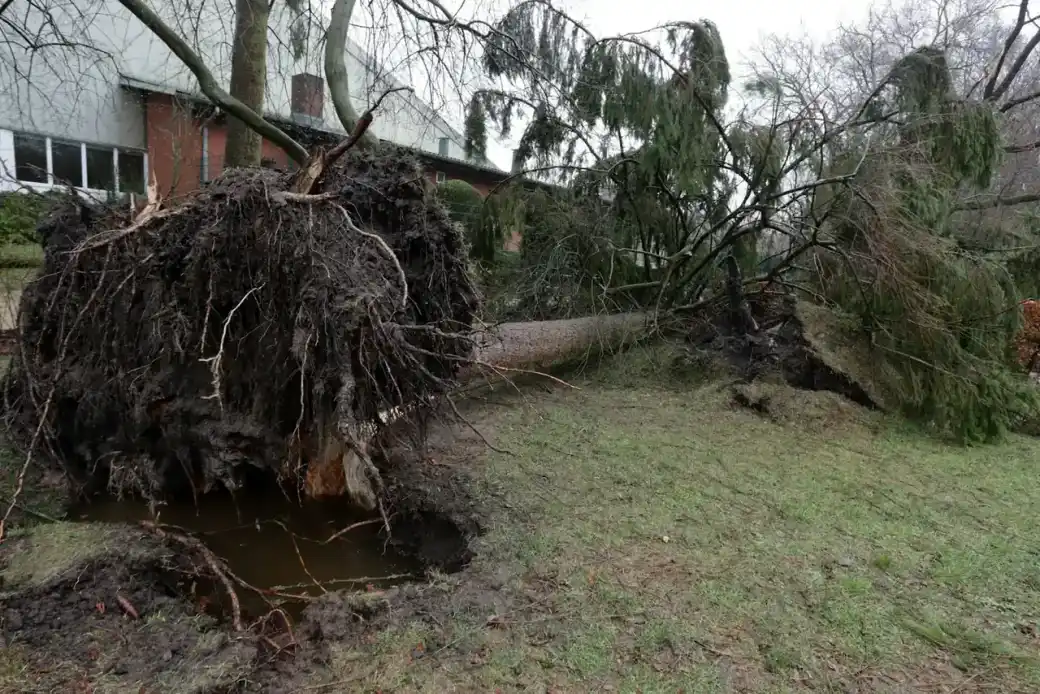
If a tree is on your house right now, stop reading and call. This page will be here afterward.
For everyone else, here is the order that keeps people safe and keeps an insurance claim from going sideways.
1. Get everyone out of that part of the house
A tree resting on a roof is holding load in ways nobody can see from inside. Ceilings can come down after the impact, not during it. Move people and pets to the other end of the house or out of it entirely.
Do not go up on the roof. Do not go into the attic to look. The tree can shift.
2. Assume every line is live
If the tree is touching a power line, or you cannot tell whether it is, treat the ground around it as energized and stay well back. Call Evergy at 800-544-4857.
The service drop running from the pole to your house is the line that comes down most often in a storm. A tree company can work around a de-energized drop. Nobody should be near a live one.
If you smell gas, get out and call 911 from outside.
3. Kill the power at the panel if you can do it safely
Only if the panel is dry, accessible, and nowhere near the damage. Water coming through a hole in the roof and reaching wiring is a fire risk. If reaching the panel means walking under the damaged section, leave it.
4. Photograph everything before anything moves
This is the step people skip and regret.
Take photos from multiple angles outside, including wide shots that show the whole tree and the whole house. Photograph the interior damage. Photograph water coming in. Get the base of the tree, the root plate, and the direction it fell.
Adjusters pay claims based on documented damage. Once a crew starts cutting, the evidence is gone.
5. Call your insurer, then a tree service
Most homeowners policies in Kansas cover tree removal when the tree hits a covered structure, and typically do not when it just falls in the yard. Policies vary, and the deductible applies either way.
Two things worth knowing:
Insurers usually cover emergency mitigation, meaning the work needed to stop further damage, such as getting the tree off and tarping the hole. Keep every receipt.
You choose the contractor. Your insurer may suggest one. You are not obligated to use them.
6. Tarp before the next rain
A hole in a roof turns into ceiling and drywall damage the moment it rains again. Emergency tarping buys time until a roofer can get scheduled, and after a regional storm that can be weeks.
A tree crew can tarp. A tarp is not a repair, and anyone who tells you otherwise is not a roofer either.
What we do on an emergency call
We answer the phone and ask what is on what. If a line is involved we tell you to call Evergy first and we wait. We quote the call-out before dispatching a crew so nobody arrives at a surprise price. On site we make the property safe first, which usually means getting the tree off the structure and tarping, and we photograph the work as we go so you have documentation for the claim. Full cleanup gets scheduled once the hazard is gone.
After the storm, look at the other trees
The tree that came down is usually not the only compromised one. Straight-line winds leave hangers, broken limbs caught up in canopies that come down later without warning, and root plates that have shifted without the tree falling.
A walk-through after a storm catches those while they are still cheap.
Services in this article
Relevant service areas
Keep reading
- When to Spray Bagworms in Kansas (Mid June) The spray window in Lawrence and Topeka is about three weeks in mid June. Miss it and you are treating a sealed bag.
- The Cheapest Time of Year for Tree Removal in Kansas Tree work in northeast Kansas is roughly twelve times busier in June than in December. Booking in the slow months is the easiest way to pay less.
- Emerald Ash Borer in Douglas and Shawnee County: Treat or Remove? EAB has been in Kansas since 2012 and is established across the northeast counties. How to tell if your ash is infested, and the point where treatment stops being worth the money.